
2-27-24 – By Douglas Smith – @optimist1961 on X, Pirates Spring Training Insiders Group on Facebook
The Home of Pittsburgh Pirates Spring Training since 1969
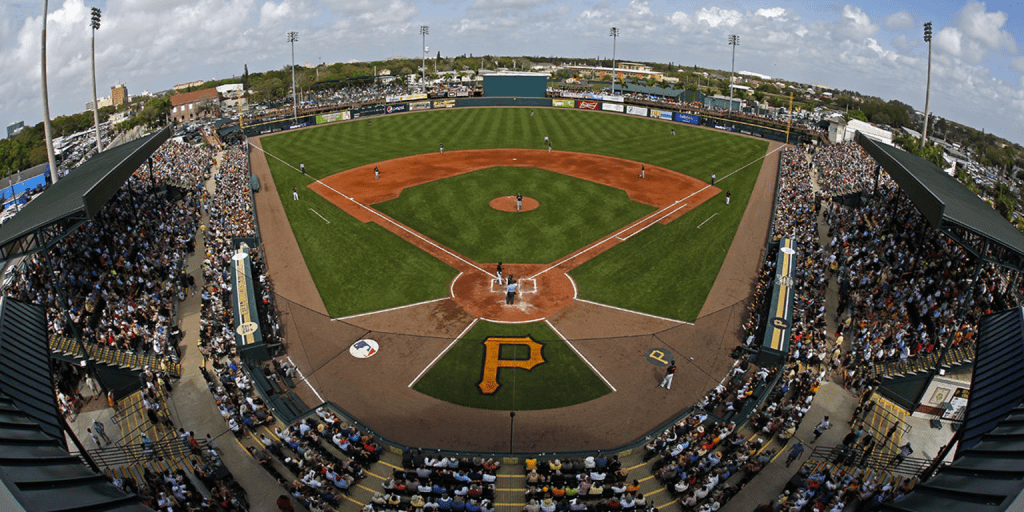
I’m a civil engineer who grew up in a baseball household where my dad was one of the early members of SABR – Society of American Baseball Researchers. I was introduced to baseball culture with a Cleveland Indians baseball mitt and trips to Municipal Stadium in downtown Cleveland. Having moved to Pittsburgh in 1986, the Pirates were easy to adopt as my team, but once I attended my first Spring Training in 2014 the affection and curiosity for the sport really blossomed.
My dad was also a major history buff so my interests skew to how interesting and connected the storylines of the players, teams and managers are across the decades. I wrote this article to expand on what I have learned as we passed the 100th anniversary of baseball in Bradenton in 2023, with an effort to weave some of the rich historic context through those 100 years.
Let’s start with a short tribute to Bill McKechnie
William Boyd McKechnie was born in Wilkinsburg, PA. to Scottish immigrants on August 7, 1886 – the same year the Statue of Liberty was dedicated in New York City by President Grover Cleveland.
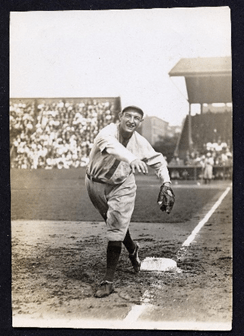
Bill McKechnie debuted for the Pittsburgh Pirates in 1907 with manager Fred Clarke. Clarke was a player-manager as Honus Wagner was in his prime leading the National League in batting average.
Bill was an infielder and went on to play for the Pirates across 4 different stints, as well as the Boston Braves (1913), New York Yankees (1913), Indianapolis Hoosiers/Newark Peppers (1914/15), the New York Giants (1916) and the Cincinnati Reds (1917).
In 1913, McKechnie had his worst season as a full-time player, batting only .134, but Yankees manager Frank Chance thought McKechnie had a keen baseball mind and had Bill sit next to him on the bench during games.
Two years later, McKechnie got his first taste of managerial duties, serving as player-manager for the Newark Peppers of the Federal League, leading the team to a 54–45 record.
He managed for a year in the minors before assuming the helm of the Pirates in 1922. He managed the Bucs from 1922 to 1926, the St. Louis Cardinals in 1928 and 1929, the Boston Braves from 1930 to 1937, and the Cincinnati Reds from 1938 to 1946. He compiled 1,896 wins and 1,723 losses for a .524 winning percentage over his managerial career. His teams won four National League pennants (1925, 1928, 1939 and 1940) and two World Series championships (1925 and 1940), and he remains the only manager to win National League pennants with three teams (Pittsburgh, St. Louis and Cincinnati).
McKechnie was an unusual kind of manager for his era. A very religious man, he did not smoke, drink alcohol or use profanity. His nickname was ‘The Deacon’. When he had a problem player who was likely to go out carousing, McKechnie’s simple solution was to room with him.
McKechnie was inducted into the Baseball Hall of Fame in 1962 and into the Cincinnati Reds Hall of Fame in 1967. He has not yet been inducted into the Pirates Hall of Fame as of 2023. McKechnie died October 29, 1965 in Bradenton, FL, where he had settled in later life. He is buried at Manasota Memorial Park, just 3.5 miles away from the park which bared his name until a few years ago.

The Roaring, then Boring 20’s
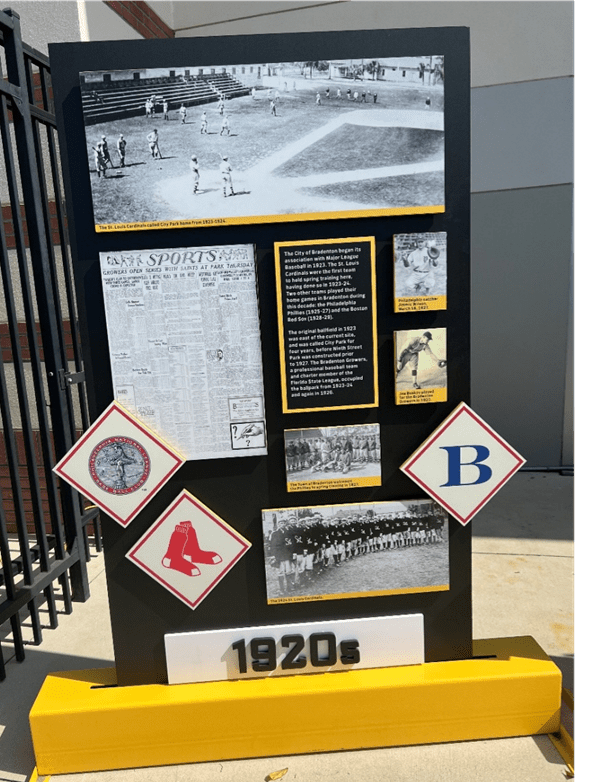
The St. Louis Cardinals were the first occupants of what was then called City Park, in ‘Bradentown’, Florida, and the location was actually east of the existing facility. A young Branch Rickey – one of the most innovative baseball managers in history – was managing the Cardinals at that time.
Rickey had basically invented the ‘farm system’ as we know it today, and at that time owned five minor league teams. He also created the Cardinal Logo that is still in place today. Rickey also introduced batting cages, pitching machines and the first team position-focused on analysis (Allan Roth in 1947).
Interestingly, Rickey went on to become an Executive VP for the Pittsburgh Pirates in 1950 (then owned by John Galbreath). He helped recruit the likes of Elroy Face, Bill Mazeroski, Dick Groat, Vern Law and Roberto Clemente. Rickey, when his health declined, chose Joe Brown to manage the club – who eventually hired Syd Thrift and Jim Leyland. I love that lineage!
The spring training facility was called ‘City Park’ from 1923 to 1926 and seated 2,000 fans. In 1926/1927, it was rebuilt at the current location: 1611 Ninth Street West and acquired the name ‘Ninth Street Park’ which lasted until 1947.
The Cardinals went on to win 79 and 76 games in 1923 and 1924, respectively. The Philadelphia Nationals (now the Phillies) occupied the facility for the next three years (1925-1927) and went on to have 65, 58 and 51 wins (finishing last that year). After the Phillies, the Boston Braves (now Atlanta Braves) were an even less illustrious resident of 9th Street Park – their records from 1928 to 1930 were 57-96 (last), 58-96 (last) and 52-102 (last).
The 1930s – Seeds of Greatness!

In 1930, the St. Louis Cardinals returned to Ninth Street Park for a six-year stay. Still run by general manager Branch Rickey, they won the Word Series in 1931 and 1934. During that period, the team adopted the nickname ‘The Gashouse Gang.’
Some say this was inspired by their star pitcher Dizzy Dean, who loved Bradenton so much he bought a gas station to run when he wasn’t playing – where his teammates would hang out as well.
Dizzy also bought a house in Palm Sola Park, one of the nicer Bradenton neighborhoods of the time.

In 1937, it’s a little unclear who occupied the Ninth Street Field. Reportedly, The Boston Bees (previously the Braves) called the park home until 1941; however, Spring Training fliers exist on eBay saying they practiced in St. Petersburg (managed in 1937 by our own Bill McKechnie).
In 1938, future Hall of Fame manager Charles Dillon “Casey” Stengel replaced McKechnie as the Bees manager, and the Bees did, in fact hold, spring training at Bradenton and went 77-75 the following season. The Bees stayed in Bradenton during the springs of 1939 (63-88-1) and 1940 (65-87) as well. Stengel was known for taking a seldom-used technique called platooning and using it much more extensively, making the most of it in later years managing the Yankees.
The 1940s – The War Years
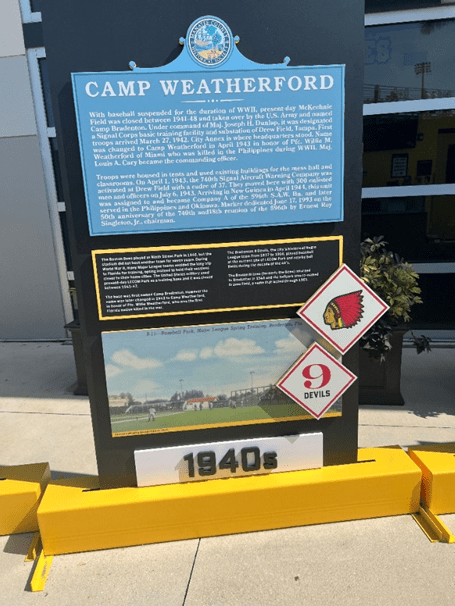
Ninth Street Park was taken over by the U.S. Army in 1941 and named Camp Bradenton, later changed to Camp Weatherford after the first Floridian to be killed in the War. They used it as a training base during World War II.
On January 15, 1942, President Franklin D Roosevelt sent a letter to Commissioner Kenesaw Mountain Landis encouraging Major League Baseball to continue playing despite the early entry into World War II. All 16 teams played a full season but Spring Training for all teams was held closer to home to save on costs.
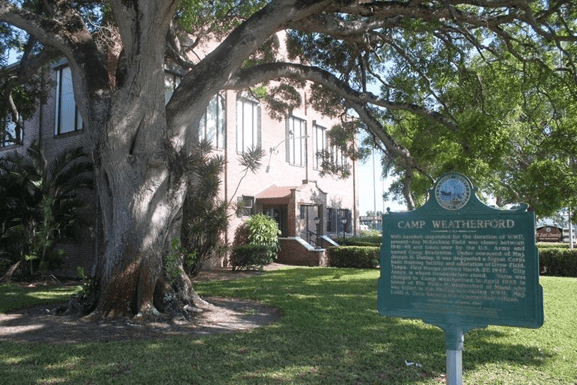
The Bradenton grounds became a Signal Corps basic training facility. The City Annex, still standing, served as headquarters for the Camp. The local camp was attached to Drew Army Field in Tampa, which later become Tampa International Airport.
The rebranded Boston Braves returned to the re-named Braves Field in 1948 and, after three decades of lackluster Braves/Bees/Braves baseball, brought home the National League Pennant that year, losing to the Cleveland Indians in the World Series. After the Braves’ first year back, the city of Bradenton stated that if the Braves agreed to return the very next season, the city would build new clubhouses, field boxes along the first and third baselines and a new press box. The Braves agreed and stayed in Bradenton until 1963.
The 1950s – A Notable Moment in Societal Change
In 1950, Bradenton became the first MLB facility to allow an African-American baseball player, Sam ‘The Jet’ Jethroe of the Boston Braves. Jethroe led the league in stolen bases in 1950 and 1951 and at 32, was voted National League Rookie of the Year (he had previously been playing for the Negro League Cleveland Buckeyes).

This was a major breakthrough because, had Florida not allowed him to join, the state would have lost all of its baseball clubs. In March 1957, the Bradenton City Council would grant permission for a semi-professional Negro league baseball team to play its 10-game home schedule at the ballpark.
The Boston Braves became the Milwaukee Braves after the 1952 season (before becoming the Atlanta Braves in 1966) but the team that occupied the Bradenton grassy fields did well during this time, finishing 1st in the National League twice, and 2nd four times, and defeated the New York Yankees in the 1957 World Series.


That year, a 23-year old Hank Aaron enjoyed the Gulf Coast’s warm air and sunshine, starting his amazing career at Braves Field, and went on to win the League MVP award, batting .322 with 44 home runs an 132 RBIs.
Despite being able to play alongside the entire team, Aaron and the other black players still had to spend Spring Training in the negro neighborhood in Bradenton staying with host families such as K.W. Gibson, a principal, and his wife, a teacher, at 211 Ninth Avenue West. Meanwhile, the white players stayed at the opulent Dixie Grande Hotel on the Manatee River.
The 1960s – The Pirates Enter the Scene (Soon)
In 1961, a young Joe Torre was brought to Spring Training with the Braves at Bradenton as a rookie catcher. He went on to be voted an All-Star five times as a player and to manage for 30 years, winning the World Series with the Yankees four times.
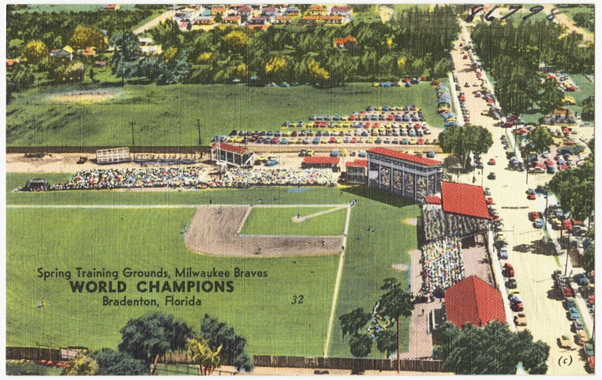
Warren Spahn, one of history’s and the Braves’ great pitchers with 363 wins, liked the area so much he bought land and built several small cottages on Ann Maria Island. Spahn spent his entire 13-year career while the Braves occupied the field in Bradenton.

The Milwaukee Braves hung around at Braves Field a little longer, 1962 being their last spring there, but 1962 was a notable year because the field was renamed after the city’s popular resident, Bill McKechnie. McKechnie had also just been inducted into the Baseball Hall of Fame as a manager, alongside Jackie Robinson and Bob Feller.
In 1963, as Milwaukee moved to West Palm Beach for the spring, they were replaced by the Kansas City Athletics, who stayed through 1968. At the end of the five years, the Athletics moved to Oakland and needed a training facility closer to the home stadium, subsequently moving to Arizona. The Athletics were basement dwellers for these five years and the team’s mascot, ‘Charley O’, was a donkey that the owner, Charley Finley would tie up in the outfield.
During their short stint in Bradenton, though, the Athletics were stockpiling young talent many of whom would see the Hall of Fame: Reggie Jackson, Rollie Fingers, Tony La Russa, and James Augustus “Catfish” Hunter.

In 1969, the Pittsburgh Pirates began their relationship with Bradenton that is now more than 50 years old. The team had started their Spring Training in Florida in 1918 and at various points were based in Jacksonville, Miami Beach, Fort Pierce and Fort Meyers. A 40 year lease was signed for Bradenton with an option for 40 more. This deal, signed under Galbreath, was one of his most lasting actions for the club.
The 1970s – The Southern City of Champions
The Pirates had won the 1960 World Series against the Yankees, and John Galbreath, a wealthy contractor and developer, had owned the club since 1946. He would sell almost half his shares in 1983, eventually selling the rest in 1986. Galbreath was a stable owner who knew baseball but he began to battle the economics of the game when Free Agency started in 1976.
When the club stepped foot on friendly McKechnie Field in 1969, the roster included pitchers Steve Blass, Jim Bunning, Dock Ellis, Bob Veale and Bob Moose. Manny Sanguillen was catching. Al Oliver, Bill Mazeroski and Richie Hebner were in the infield. The outfield had Robert Clemente and Matty Alou. It shouldn’t be a surprise they went on to win the 1971 World Series, beating the Baltimore Orioles with Clemente having an MVP performance at age 37, batting .414 in the series. Three Rivers Stadium was only a year old.
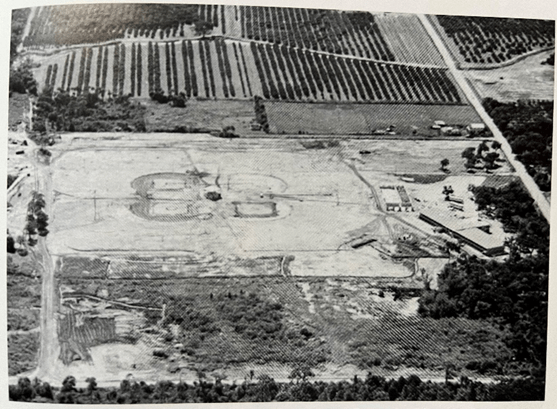
In conjunction with the Pirates arrival came the construction of Pirate City.
The 1980s – A Time for Change

Pirates outfielder Dave Parker once said “playing in the outfield [at McKechnie] was like playing in a potato patch.” The reputation as an underwhelming facility was known league-wide, so eventually, the city installed new grass and built new clubhouses, a grandstand and a press box in the 1980s. McKechnie was still the oldest spring training facility in Florida with all the issues that come with that, so city officials agreed to give the Pirates a renovated stadium to make sure they would stay.

Chuck Tanner still led the Buccos through two winning seasons in 1982 and 1983, but with a 57-104 record in 1985, Tanner and GM Hardy Peterson were asked to leave as Galbreath sold his remaining stake in the club.
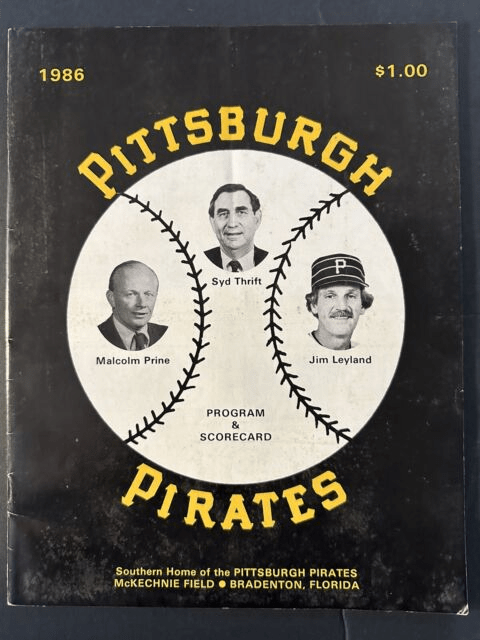
41 year-old Jim Leyland took the helm, never having managed an MLB club. The material he had to work with wasn’t bad: Rafael Belliard (age 24), Barry Bonds (21), Bobby Bonilla (23), Sid Bream (25), Joe Ursulak (24), Tony Pena (29), John Smiley (21), and Bob Walk (29). The great scouting had still been going on in the background.
The atmosphere was said to be very professional, positive, focused on excellent player development, and Leyland was both as good a game strategist as he was a coach. Syd Thrift, the new GM, came from a long and successful career in scouting, and was a compliment to Leyland because he was very visible and involved with the players day to day at Spring Training.
As a result of this great baseball environment improvement was rapid, never losing 100 or more games in a season. 1986 saw 64-98, but after that the records were 80-82 (1987) and 85-75 (1988). Syd Thrift left in October 1988.
In 1989 the club made modest improvements with a 74-88-2 record, but in 1990 they broke through, finishing 95-67. They, unfortunately, lost to the Reds in the NL Championship Series. 1990 was also the year Cameron Hubert Bonifay came aboard as scouting director. He was with the team for 11 years. Cam is 72 this year and lives right up the road from LECOM in St. Petersburg, FL.
The 1990s – A Spark, then Darkness
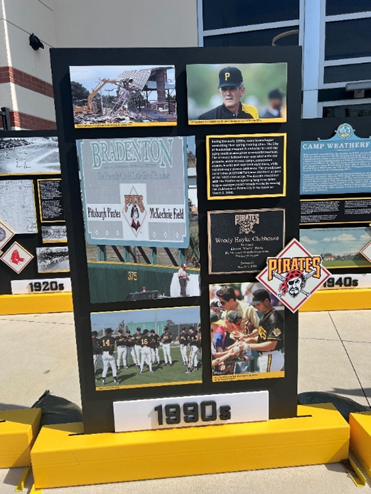
1990, 1991 and 1992, the Pirates reached the National League Championship, losing those to the Reds, then twice to the Atlanta Braves. Ted Turner was beginning to step back from meddling with Baseball operations in Atlanta and they became a pitching juggernaut, finally winning the World Series in 1995.
Even though the Pirates had not won a pennant their success prompted another renovation at McKechnie Field that was barely finished by Spring Training in 1993, taking a great deal of inspiration from Forbes Field. The facade was designed to echo the old Spanish Mission style Bradenton railroad station. The ballpark was heralded by George Will (a part owner of the Orioles at that time), USA Today. The architect, Lou Astorino, eventually went on to design PNC Park as well, opening in 2001.
1994 brought the eighth, and longest, strike of Major League Baseball history. The last 50 games were cancelled and, for the first time since 1904, a World Series was not played. After 232 days, the strike ended resulting in an abbreviated 1995 series of 144 games, commencing on April 2, 1995 – I am not sure but I assume Spring Training was skipped that year. Attendance decreased 20% from 1994 levels. Many fans where angry. The game was in crisis.
Kevin McClatchy – who is two year younger than the author – became the managing owner of the Pirates in February 1996 at age 33. He would remain in the role until stepping down as CEO in 2007, after 21 years.
In September of 1996, unhappy with the new ownership group’s slashing of payroll, Leyland asked to resign and McClatchy released him from the final four years of his contract. Cam Bonifay hired Gene Lamont as field manager. Lamont was the manager through the remainder of the 1990s, but was asked to leave after the 2000 season four losing seasons.
In the late 1990s a campaign started to use mostly public funding to replace Three Rivers Stadium with two sport-specific stadiums.
The Two Thousand Aughts


Brand new PNC Park opened for the 2001 season with much fanfare – it was the fifth home of the Pirates, returning to the North Shore. The MLB All- Star game was held there in 2006. In 2009, The Pirates reached the end of their 40 year contract with Bradenton as occupants of McKechnie Field. It was a fine facility and they decided to continue on.
There were new improvements at McKechnie Field in 2008 as well – a new visitors clubhouse, a new press lounge, and lights. In addition improvements were made at Pirates City, partially funded by the state to support keeping baseball in Florida. The partnership has been good over the years.
But the Pirates were still in the early years of a streak of 20 losing seasons. After Gene Lamont was released, 2001 brought former Pirate Lloyd McClendon back to McKechnie Field and the new PNC Park as the new manager. McClendon brought energy and real player experience to the job, but after five seasons was not able to break .500 and was replaced by new fourth-year GM Dave Littlefield during the 2005 season with Pete Mackanin. The next year, Jim Tracy, who had moderate success with the Dodgers, was brought in. I met Jim Leyland in the mall that year and he vouched for Tracy as a good baseball man who would help – always the class act, Mr. Leyland.
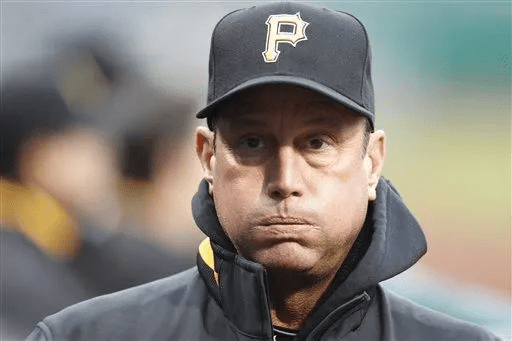
Tracy oversaw two more losing seasons and was gone. New GM Neal Huntington replaced Tracy with John Russell who closed out the 00s with three more losing seasons and went 186-299 (.324).
The 2010s – ‘Reconnecting with the City’
In 2011 a very interesting manager was brought in to lead the club – a smart man, a man with passion, and a many who knew about being saved – Clint Hurdle. Perhaps more than the rest of Pirates ownership or management, he knew his real job was to reconnect the ballclub with the City and the fans.

Among the long list of players that greeted the new manager at sunny Bradenton were – well when I review the list I recognize a few, but the list doesn’t knock me over: Josh Harrison, Jameson Taillon, Neal Walker, Gregory Polanco, Gift Ngope, Dovydas Neverauskas, Jordy Mercer and Jared Hughes and Starling Marte. Oh – and Drew Maggi! But they drafted Gerrit Cole that year. Taillon was the previous year. Hard to believe McCutchen was drafted way back in 2005.
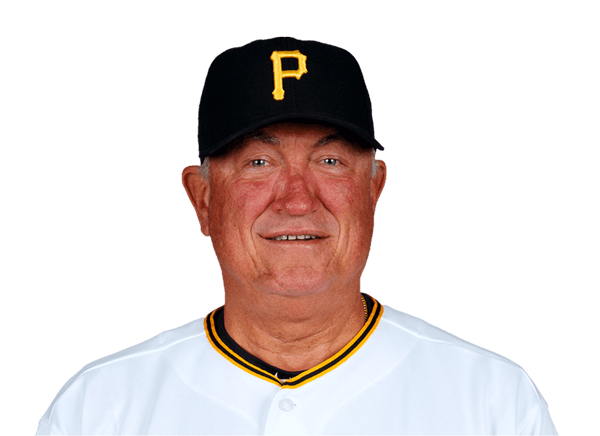
Hurdle is a fascinating man. My wife and her friend are a little head over heels about him! After watching Hurdle manage the team for a year and not knowing his story, I told my smitten wife ‘…it looks to me like he’s lived – well, a little bit of a rough life.’
Hurdle had indeed had a tumultuous youth, but had found ways to recover, overcome and excel, and he was one of the old school managers who just knew more than the other guys. But he also built extraordinary teamwork among, and insight into, his players. He was also not shy about bringing his faith into the clubhouse and his relationships with players. So now I’m the one who’s a little head over heels, and I read his emails every day (except Sundays).
Spring Training must have been more fun each year as the club climbed from 72-90 in 2011 to 98-64 in 2015. In early 2012, as a continued advancement of the partnership with the Pirates, Bradenton officials helped pay for $7.5 million in renovations to McKechnie, including new seating, enhanced fan plazas, a tiki bar, more concession stands, restroom improvements, an upgraded sound system, scoreboard and a boardwalk which would circumnavigate the stadium.

Under the deal, the Pittsburgh Pirates, who contributed the equivalent of $150,000 annually to market the city of Bradenton, planned to increase their marketing donation to $400,000 annually. In a deal with the Lake Erie College of Osteopathic Medicine, the Pirates renamed it LECOM Field in 2017, but named the player clubhouse after McKechnie.
2013-2014-2015 have been the most exciting seasons in decades. In 2013, the club won a 1-game Wild Card game vs the Reds to enter the post-season, but lost to the Cardinals 3-2. In a recent article, I read that in 2015 when Neal Huntington proposed a new Performance Center at Pirates City, an enlarged clubhouse at McKechnie Field, and new media center, ownership told him to get the $8M in costs from baseball operations (mostly payroll). That choice had meaningful and negative consequences. After 2015, the club started to disinvest in the team, payroll dropping from $99 million in 2016 to $45 million in 2021. Huntington, Hurdle and President Frank Connelly were let go in 2019.
While the residue from the Huntington/Hurdle era in the 2010s left a great club culture and rebuilt the support of the fans and City of Pittsburgh, it also established expectations. My first few years attending Spring Training also expanded my support and expectations of the franchise but the ultimate expectation of a fans is much more in team wins than tiki bars and Jumbotrons. Although they don’t hurt!
Bradenton and its surroundings wove their magic on Clint Hurdle like they have on so many other players and managers. He bought a house on Anna Maria Island and lives there with his family. He works for the the Rockies in player development, but travels and speaks extensively for many organizations. He holds an annual fundraiser during the last week of Spring Training for Prader-Willy Syndrome and it’s a great event.
The 2020s – Where We Are
In 2020, Ben Cherington was hired as General Manager, Travis Williams as club President and Derek Shelton as field manger. During the changeover, Bob Nutting expressed his desire to see better player development so as not to see players the Pirates drafted go elsewhere and play better. Cherington has brought in many cutting edge approaches to player development and game strategy. The jury is still out on the new approaches but the fan base remembers Hurdle and Leyland, two ‘old school’ managers, as the most recent proven successes in Pittsburgh.
LECOM and Pirates City are great facilities that are not only fan friendly but wonderful resources that are utilized year-round. Many people make an annual trek to Bradenton and enjoy the emergence of new prospects as well as close-up interaction with beloved veterans.
In 2023, Bradenton, the Pirates and LECOM celebrated 100 years of Spring Training in that location, and the Pirate’s Jim Trdinich produced the display boards shown above in each decade. He used the book ‘Spring Training in Bradenton and Sarasota’ by Raymond Sinibaldi as a resource for much the material. Several members of the Baseball Hall of Fame, such as Roberto Alomar, Johnny Bench, Bert Blyleven, Wade Boggs, Roberto Clemente, Andre Dawson, Vladimir Guerrero, Roy Halladay, Reggie Jackson, Fred McGriff, Bill Mazeroski, Joe Morgan, Jack Morris, Phil Niekro, David Ortiz, Mike Piazza, Tim Raines, Cal Ripken Jr., Mariano Rivera, Ivan Rodriguez, Babe Ruth, Mike Schmidt, Tom Seaver, Willie Stargell, Alan Trammell, Larry Walker, Ted Williams, Dave Winfield, have played on these historic fields and grown to love their temporary Gulf Coast home.

LECOM Field is the oldest stadium still in use for Spring Training.
 Steel City Pirates