Through The Prospect Porthole: Carving Up The Complex League

2-26-22 By Craig W. Toth (aka @BucsBasement On Twitter)

A couple of blog posts ago I wrote about the general overuse of the terms underrated, overrated, under the radar, relative unknown, forgotten or even breakout when it came to describing Pirates Prospects in the Farm System. Towards the end of my rant piece I made mention about the possibility of bringing up names from either the Florida Complex and/or Dominican Summer Leagues if you really wanted to talk about players with little to no publicity. Well, that’s pretty much where I am right about now.

After nearly three months with no real baseball news to be discussed I found myself perusing the stat lines of the Pirates Black and Gold Teams to pass the time one evening last week, while patiently awaiting the start of Minor League Spring Training.

In the past my focus had been drawn toward the position players on the roster; specifically Tsung Che-Cheng, the Romeros, Sergio Campagna and Rodolfo Nolasco. However, this time it was several of the young arms that caught my eye; mostly in terms of their ability to generate the swing and miss. For some it also didn’t hurt that they had a tendency to keep runners off the base paths in general.

Now obviously I completely understand that the performances of players from 18 to 22 years old will do little to move the needle for the casual Pirates Fan; especially those that have yet to make their way out of the Sunshine State. I am also well aware that the chances of even one of these prospects eventually taking the field at PNC Park-or at the Major League Level in general-is extraordinarily slim.

On the other hand it’s not like every single player experienced success in the FCL, so why not given credit where credit is due?

1) Joelvis Del Rosario

Signed by the Pirates in January of 2018, a few months before his 17th Birthday, Del Rosario would began his professional career later that summer with a brief appearance in the DSL; only totaling 11 innings before returning to the same Pirates1 team the following season. Over two years and 61.1 innings the young Dominican right-hander would post a 3.08 ERA and a 1.21 WHIP with 47 strikeouts and 22 walks. On the surface a couple of these numbers were less than overwhelming, specifically his strikeout to walk ratio; yet, it always seemed liked there was some sort of underlying promise for improvement due to how in command and in control he appeared to be on the mound.

When MiLB finally resumed play this past summer, Del Rosario finally had the opportunity to tap into at least a portion of this potential. In another small sample size-only 38.2 innings-he saw his K/9 jump to 12.10, while his BB/9 and ERA remained consistent at 2.33 and 3.26.

In spite of his improved performance some durability concerns have been raised due to Del Rosario’s size-5’11 170 pounds, which would make a transition to a relief role more likely; although it should be noted that on paper he was more effective as a starter, with a 1.93 ERA and .964 WHIP versus a 6.75 ERA and 1.406 WHIP out of the pen.

2) Valentin Linarez

In direct contrast to Del Rosario, Linarez stands 6’5” and weighs in at 225 pounds; looking the part of a starting pitcher, and even bigger in person if you can believe it.

Signed by Pirates in January of 2018, this imposing figure from the Dominican Republic split time between the bullpen and the rotation during his first professional season in the DSL; finding more success in the former role. Overall he struggled with command, which led to a BB/9 rate of 5.0 and K/9 rate of 6.6.

Returning to the DSL in 2019, Linarez worked strictly as a member of the rotation; starting 12 games, pitching 55.1 innings and making clear improvements across the board. His BB/9 dropped to 2.3, his K/9 raised to 8.9 and both his ERA (2.28) and WHIP 1.03) were better for it.

Due to the positive steps he had made throughout the season it was likely that complex league would be in the plans for 2020. Nevertheless, this promotion would have to wait until this last summer, where it quickly became apparent that he was likely more advanced than this assignment. Sure his walk rate elevated back up to 4.1 BB/9, but his K/9 also took a jump to 14.3; ultimately resulting in a bump up to High-A Greensboro towards the end of season when they were in need of a few arms to help them finish out the year. In 2 starts and across 9 innings, Linarez walked 2 and struck out 7, however he also gave up 3 homers-all of which took place on the road, just in case anyone thought it had something to do with the First National Bank Effect.

Because of his age, a looming service time decision-Rule 5 Eligible in December of 2022-and the fact he was there already, it probably makes sense that he would start the year with the Grasshoppers; hopefully to figure out his eventual role, as well as to see if he can find some balance between his walk and strikeout rates.

3) Darvin Garcia

When Garcia was signed by the Pirates in July of 2019 he had already turned 20 years old, so it only made sense to immediately get him some action in the DSL. Over an extremely small sample size of 11.1 innings-and looking very raw-the 6’3” native of the Dominican Republic walked 5 batters and struck out 15, all in a relief role.

Upon his arrival in the FCL this past summer, the now 22 year-old once again found his place in the bullpen; this time will a little more control. Over 33 innings of relief he kept his strikeout rate fairly high at an even 12 batters per 9, while lowering his walk rate from 4 to 2.5.

Set to turn 23 shortly after the start of the upcoming season, Garcia is likely to join Linarez in Greensboro, with the hope that he continue to miss bats at a similar rate.

4) Carlos Jimenez

In spite of still being 16 years old when the 2019 season began, and missing a month’s worth of games during the year, Jimenez’s professional debut was pretty impressive. Over 10 starts and 39 innings the 6’2” Venezuelan posted a 2.54 ERA, a 1.359 WHIP and 10.4 K/9 to 3.9 BB/9. At his age it was a forgone conclusion that 2020 would be a repeat of the DSL, with hopes of advancing to the states in 2021.

Clearly the second part of this plan worked itself out, as he would make his stateside debut for the Pirates Black Squad at the end of June. At nearly 3 years younger than the average player in the league, Jimenez improved upon his WHIP (1.165) and K/9 (11.5), but saw a slight bump in his ERA (3.15); although, it would be the stagnant BB/9 (3.9) continues to raise a little bit of concern from some scouts. However, at that point I could just refer back to the right-hander’s age, his limited experience and the obvious consequences of a year without baseball.

For these three reasons-along with the fact that he has a solid three pitch mix, which includes an above average changeup-it’s easy to see the potential for Jimenez to show improvement when he takes the mound in the FCL and/or with the Marauders this summer.

5) Po-Yu Chen

Of the five pitchers mentioned in this post, Chen is clearly the most recognizable name; mainly due the fact of how, when and by whom he was acquired.

On August 28, 2020 the Pirates-and more specifically Ben Cherington-traded outfielder Jarod Dyson to the Chicago White Sox in exchange for an additional $243,300 of international bonus pool space; a bump in available funds that they almost immediately put into signing this 22nd Ranked International Prospect of the 2019–20 Class, from Taiwan, for $1.25 million.

In 2019 the 6’2” 198 pound right-handed hurler pitched in the WSBC U-18 Baseball World Cup, where he put up a 1.29 ERA over a total of 14 innings thanks to his high 80s/low 90s sinking fastball, curve ball and somewhat advanced changeup.

With the Pirates, Chen would begin his professional career in the aforementioned FCL; a situation in which he was nothing shorting of dominating. Over 26 innings of work he did not walk a single batter, struck out 29-good for a rate of 10.0 K/9-and posted an nearly identical 0.69 ERA and .692 WHIP.

Unfortunately his transition to Low-A Bradenton did not go smoothly as put up a 5.63 ERA and a 1.688 WHIP, while walking 12 and striking out 15; although his one start was a 7 inning, 3 hit, 0 run and 6 K performance.

Now, as far as Chen’s future is concerned, I still hold the same belief that I did the last time I wrote about it; which is that much of his success-or lack thereof-will depend on his ability to add strength and velocity.

Conclusion

As much as I like pouring over over stats, projections, rankings, etc., it’s time to have baseball back; because in all honesty, this off-season has felt like an eternity. Yes, I realize I have college games to watch, with a Minor League Season on the way; but without MLB, it kind of feels incomplete.

Obviously, I will continue to provide updates on analysis on players in the Pirates Farm System, including these five young men. It’s what I’ve done ever since I started blogging about the team over two years ago. The only difference is that it becomes much harder to envision their individual developmental paths from level to level-and hopefully to Pittsburgh one day-without a clear picture of the depth that lies in front of them.

Travis Swaggerty is Worthy of Excitement

2-25-22 – By Ethan Smith – @mvp_EtHaN on Twitter

***First a little note of welcome from us here at Inside the Bucs Basement, specifically Gary as it were. Ethan is a young Pirates fan who’s brought stability to the Locked on Pirates Podcast by holding the host duties longer than anyone as of late. He’s never afraid to say he’s learning and we are excited to give him a place to hone his skills as a writer and take advantage of his youthful energy. You’ll see more from him on here, especially when baseball gets it’s act together and plays games. Welcome Ethan, and give him a follow if you don’t already.

The Pittsburgh Pirates are in the rebuilding stages and with those stages comes new waves of young players to be excited for as fans of the team, but every prospect comes with caution even if many in the system right now come with more excitement than caution. 

One of these players is 2018 first round selection, outfielder Travis Swaggerty, who this off-season saw himself added to the 40-man roster alongside outfielders Canaan Smith-Njigba, acquired in the Jameson Taillon deal to the Yankees and newly acquired Jack Suwinski from the San Diego Padres in exchange for Adam Frazier last season. None of these players have seen MLB action yet in their young careers, but statistically speaking from their respective times in the minor leagues, Travis Swaggerty has an advantage over some of the other young outfielders in the system.

I actually got the chance to speak with Swaggerty in an interview on the Locked On Pirates Podcast where he spoke in length about rehabbing from his shoulder surgery this past season and how much better he feels now.

“I got surgery in June, it was a four to six month recovery, so I started hitting in November and since then it has been smooth sailing.”

TRAVIS SWAGGERTY – lOCKED ON pIRATES

Smooth sailing is a perfect way to describe Swaggerty’s swing, which has considerably improved since his time at South Alabama and continued to do so after his time with the West Virginia Power and Bradenton Marauders. In 2019, Swaggerty’s best season in the minor leagues by far, he slashed .265/.347/.381 with a .728 OPS, and 2019 also happens to be his last full season of minor league baseball to date with the 2020 season seeing no minor league action and his season being cut brutally short in 2021.

There is cause for concern health wise after a shoulder injury, but Swaggerty assured me that he will bounce back and only continue to improve.

“I feel pretty good right now, swing feels great, arm feels great, I’m just ready to get this going.” 

TRAVIS SWAGGERTY – LOCKED ON pIRATES

Now getting things going is the most important thing for Swaggerty at this point in his career, seeing as he is now on the 40-man roster and hasn’t played baseball since May of 2021, but one major part of his game that will age like fine wine for him is his defensive ability in the outfield. 

Defensively, Swaggerty has played centerfield his entire minor league career and has posted a .981 fielding percentage, for comparison Smith-Njigba has posted a .979 and Suwinski has posted a .979, so Swaggerty offers an advantage defensively from these two guys mainly in the putouts department, specifically his 320 PO season in Bradenton in 2019. 

To put it simply, Swaggerty is a ballhawk in the outfield defensively, being a natural tracker of the baseball and what moves he needs to make next to prevent extra base hits and keep runs off the board. Swaggerty spoke highly of himself defensively as well.

“I feel like I can bring Gold Glove caliber defense wherever it may be in the outfield.”

travis swaggerty – locked on pirates

His statistics and general play back that up defensively as I mentioned earlier, and pairing Swaggerty and Bryan Reynolds in the outfield is a scary good defensive duo bearing in mind that Ben Gamel would be in the fold as well after a solid season last year with the glove in Pittsburgh. 

So, of course Swaggerty is someone to be excited for because why not? He has yet to see action in the big leagues, his minor league track record is good, he’s a smooth hitter of the baseball and plays well defensively and has been highly touted in the system for some time, so why not be excited to see what he can bring to the table in 2022? 

As mentioned earlier, there is always cause for concern with prospects and young players because they are all virtually unknown commodities until they prove their worth at the MLB level, but Swaggerty has a certain swagger and gameplay style that I think can translate to a solid defensive outfielder who hits around .240-.260 every season and brings mostly positive things to the lineup day-in and day-out. 

The 2022 season will likely be cut short due to the current CBA negotiations, but I fully expect Swaggerty to make his big league debut at some point this season and burst onto the scene to make a real impact and he expects himself to do the same.

“The goal is to be there and stay there.”

travis swaggerty – locked on Pirates

Top Prospects Guess

2-24-22 – By Justin Verno – @JV_PITT on Twitter

Recently Fangraphs updated the Pirates top prospects list. If you haven’t checked it out, please give a look. For one, Fangraphs is awesome. Two, Fangraphs writers get paid off the clicks. Three, the list is solid. And four, it’s the list Joe and I have gone off of for our trade pieces, as well as for the prospect updates I did last year. You’ll thank me later.

Speaking of those prospects updates, in the last installment I included a prediction (that was bound to be wrong) where I thought some changes to the list would occur. Let’s take a look at how I did. (Truth be told, I feel pretty good about the results.) Let’s start at the top.

I predicted that Oneil Cruz, Nick Gonzales, Roansy Contreras and Quinn Priester would all get bumps and Cruz would be 60 FV. Oneil Cruz did in fact get a bump to a 60 FV. The others? They all stayed at a 50 FV, so I missed there. And that’s ok, as I think all three will be in line for a fast bump with a fast start.

I predicted Yajure, Swags and Peguero would all stay at a 50 FV. Yajure and Swags both lost the 50 FV and were dropped to a 45 FV. I’m not going to beat myself up there. Injury played into both as Swaggerty is no longer young for the level, and Miguel just never settled in. Peguero not only kept the 50 FV but moved up the list ever so slightly, and I’d say if the power continues to develop and the contact numbers are good, he could see a bump before 2022 is over.

I predicted Tahnaj Thomas would fall out of the top 10 and as low as a 40+. He fell to a 35+. The control here has a long way to go and honestly, the K rate just isn’t as promising as the stuff suggests it should be.

Did Matt Fraizer and Endy Rodriguez jump as high as I thought they would? A solid yes. I predicted both would be in the Bucs top 10 and both should see a 45-50 FV. They split those numbers and are both 45+ FV. Did Po-Yu Chen get his 40+? Well, no, but close enough coming in with a 40 FV.

Did Ji-hwan Bae get bumped to a 45+? Nope, I missed there.

Next prediction? I said Maikol Escotto, Camren Mlodzinski and Jared Jones all get a 45 FV. Jones is the only one of the three that got the 45 FV and if he keeps missing bats at this clip and gets a hair better with the control, he’ll be a 50 FV soon enough. Escotto stayed flat at 40+ but Mlodzinski dropped to a 40 FV. And that was the first surprise of the list, injury? Not sure what they saw there we didn’t.

As for Diego Castillo and Rudolpho Castro? They stayed at their 40+ and 40 FV’s respectively. (Castro actually fell to a 40 FV from 40+ so I missed there.)

I said Jared Oliva, Jose Sariano, Luis Oviedo, Max Kranick and Steve Jennings would drop off the list. While Oviedo and Sariano dropped off, Jennings, Kranick and Oliva stuck around.

Tucapita Marcano did drop to a 35+(this was as easy a prediction as I had on here).

I pondered if Jared Triolo, Jackson Glenn, Austin Roberts and Michael Burrows could see surprise bumps. Jackson Glenn is now on the list with a 35+. Roberts and Triolo stayed at their 40 FV. However, Michael Burrows did in fact get a bump to a 45. Burrows is also a guy to watch here. His change up is coming along as he only used it 9% of the time and he didn’t pitch deep into games, but he has a shot here.

My last prediction was there would be six new names to the list. Geovanny Planchart, Dariel Lopez, Jauri Custidio, Omar Cruz and Tsung-Che Cheng. How’d I’d do there?

Tsung Che-Cheng, yes coming in with a 35+.

Dariel Lopez, yes, with a HUGE jump to a 40+.

Omar Cruz, check! 35+.

I missed on Jauri Custidio and Geovanny Planchart. Planchart is my biggest missed prediction as I had him with Fraizer and Endy as one of the biggest raisers on the list. If he gets stateside and looks good, I think he makes the jump by years end.

I had a lot of fun going through this and would love to hear from the peanut gallery. Who’d Fangraphs get wrong here? Who did they overvalue? Undervalue? Who’d they leave off? Hit me up! @JV_PITT

Prospects Alone Won’t Get the Job Done in Pittsburgh

2-23-22 – By Gary Morgan – @garymo2007 on Twitter

The goal is to win a championship, right?

I mean if being competitive was enough for fans, I’d say the three years the Pirates reached the playoffs in the last decade would be seen as more of a success. Well folks, I’m here to tell you, that goal simply isn’t going to come without getting parts and pieces from elsewhere.

It’s funny, all many have wanted to tell you are things like ‘trust the process!’ or ‘they have to build through the system!’, now all of the sudden I’m here telling you, eh, I know you’ve picked prospects you really believe in, but some of them are gonna get traded.

Well, that’s all part of the process folks were telling you to trust. At some point this team will have to go get major league players to fill major league roles. In a normal market, I’d probably just be telling you they’ll have to spend money or sign some guys. In this market, I’m telling you when the time comes Ben Cherington will have to spend some of the savings account he’s been hoarding since he got here, in the form of prospect capital.

I’m not saying that time is now, but I’m also not saying it for sure shouldn’t be. When you’re building a team you must recognize where the holes are in your system, of course try to fill them with prospects to develop, but at the same time understand where you have so many a blockade is set up where you can trade from strength.

If that guy you want and need comes available now, you can’t let a silly perceived timeline deter you from making the move. If for instance the Pirates we mentioned earlier from last decade had done that, they never go get AJ.

It’s an important period of time for this effort. Selfishly, it’s a much more fun time to talk about the rebuild process, because I can start brainstorming real baseball trades. You know, like this team needs an upgrade here, what do we have in the stock room we can move to get it? As opposed to who can we get for one of our few really good players who might be good 4 years from now?

Doesn’t mean there won’t be more conversations like that, but where we are now is a different level in which we get to start daring to consider it ok to actually, you know, improve the major league product.

I’m not blind, some of you have been at this point through this whole damn thing. I’m hoping as you watch over the next year or two some of the prospect that came in get sent out for MLB players in return, you at least see why that part had to happen.

I just caution you, if and when this build comes together, it won’t be 100% constructed from this farm system. Just won’t.

I’m not here to predict which prospects will get moved or who they should target, but the fact we’ll eventually get to this point is the safest bet in sports. It’s not even just because the system is incapable of providing, it’s more about timing.

I’m a firm believer in precursors. In chemistry or team building you can’t just put a bunch of players (or substances) together and get the reaction you’re looking for, sometimes you need a precursor that pulls everything together. That’s exactly what AJ was for this team. He brought moxie along with his skills. He showed this group of kids it wasn’t just ok to expect to win every night, it should be expected as a professional athlete.

It was suddenly ok to be proud of your team, it was for the first time in seemingly forever ok to not use the franchise history as a crutch.

He was the straw that stirred the drink and under his shadow others blossomed into leaders themselves.

More than anything, you might have a more talented team with nothing but a bunch of 1st or 2nd year players, but the likelihood it pulls together into a winning squad is asking a bit much.

There’s a reason you can’t point to a club that developed everything and won without making moves to pull it off.

Just look at these numbers.

66% of first round picks make MLB. That means just play in the league, not succeed. In other words, Cole Tucker, Kevin Newman, and Will Craig are all in that 66% win rate.

Round 2 it drops all the way to 49%.

Rounds 3-5 and the percentage drops to 32%.

6-10, you guessed it didn’t you? Down to 20% and so on and so on.

In other words, as sexy as that draft was on paper last season for the Pirates, the likelihood that the top 5 picks all make the league, let alone turn into stars isn’t high.

I don’t say this to discourage you, I still think stacking prospects as the Pirates have is the best way to mitigate this reality. I bring it up because when the time comes and the Pirates decide to move someone like a Bubba Chandler (chill it’s just an example, not a prediction) for that first baseman they need or a locked on veteran starter, the odds are on their side this time.

Of course they should sign free agents as well, but let’s face it, that’s not going to slap fans who’ve been conditioned to scour the prospect rankings in the face, this stuff will.

Stacking prospects can work to a degree, but as we just saw this off season, at some point protecting all of them becomes impossible, so of course you’re going to consider moving some of them.

I commend some of you who’ve bought into a process you were absolutely not on board with when it started. It’s because of that admiration I feel the need to prepare you for some of the product of that work heading right back out the door.

What Really Matters For The Pirates In 2022?

https://www.podbean.com/media/share/pb-gqeun-11b280b

Monday may have been the most progressive day in the CBA Negotiations thus far, but are you terribly concerned about what actually ends up in the final agreement? Sure we are going to break it all down for you, but then robot umps whisk us away to another part of the multiverse. Upon our return at the end of the 2022 season, what will truly matter when evaluating this season of Pittsburgh Pirates baseball?

Craig Toth covers the Pirates for Inside The Bucs Basement, and joins his buddy Chris at a 9-foot homemade oak bar to talk Pittsburgh Pirates Baseball. Listen. Subscribe. Share. It’s “30 Minutes Of Bucs” and THE Pirates Fan Podcast found EVERYWHERE podcasts can be found and always at BucsInTheBasement.com!

Five Pirates Thoughts at Five

2-21-22 – By Gary Morgan – @garymo2007 on Twitter

Well, I can’t and won’t sit here and tell you it’ll be productive, but this week sure promises to be newsy. Either way, the business of baseball marches on.

1. Get Better Continues

By the end of this week, the Pirates will have roughly 100 members of their 180 man player allotment in Bradenton for Minor League Camp and a continuation of the Get Better at Baseball initiative. Which is really funny when you think about it, cause if that’s not always to goal, I mean, what the hell are we doing here?

Bottom line, this is going to be a nice showcase for guys who usually would have been a bit buried by the MLB Spring Training going on. Players who have been working all off season to change something, hone a swing change, dial in a new pitch, maybe even just show that this year the K rate is going to head in the right direction.

It’s part of what you love to see at Spring Training, minus the interaction of youngsters with veterans. Taking into consideration the Pirates have precious few of those anyhow.

2. More Doesn’t Always Equal Better

I’ve seen quite a few comments stating that MLB and MLBPA finally deciding to meet daily this week is what they should have been doing all along. Man, I really don’t think so.

I could argue of course they shouldn’t have waited 42 days to bother talking, but daily meetings on something like this isn’t without risk. Animosity generated daily with no breaks to allow it to dissipate can sometimes create the opposite of what you think you’re trying to do.

I’m not trying to say they haven’t been slow walking this thing, I’m just saying this has no guarantee to be productive. According to Alex Stumpf over at DK Pittsburgh Sports, the players feel they could be ready after a month of training, so the timing of this sense of urgency is well placed with the planned start of the regular season being March 31st.

Want a prediction? Well, how’s this? If there is an agreement this week, it’ll be because the players either drop the bonus pool for young players entirely, or dropped their ask by 75 Million.

Someone has to move big somewhere or entirely drop an initiative or the regular season is simply not starting on time.

3. Isn’t the Competitive Balance Tax Already a Cap?

I mean, sorta.

It’s being treated like one anyway by most teams. It’s actually apropo that they called it a tax, cause if you can find a way to not pay them and still do well for yourself, guess what you try to do? Eventually that’s what has come to be, a funding mechanism for competitive balance has simply become a line most just try to stay under. Some could, and I’m sure do, argue that his is what the league intended all along.

It’s for that reason I never liked the lowering of and increased penalty version of the CBT. It would simply create the same thing. At first teams would just blow past it, over a short period of time, most would stay under it. As the funding mechanism for the proposed 100 million dollar floor was primarily based on increased tax payments, I never thought is was sustainable. That said, I wouldn’t argue if you said these teams should be able to spend 100 million as it is already anyway.

When sharing is based on an arbitrary tax, it’s hard for me to envision the recipient teams feeling comfortable spending it like most teams would. Follow me here, if you typically get 20 million from tax payers, it’s not like you can just assume you get that every year, so it stands to reason you couldn’t consistently factor it into your budget. Point being, I think there is still certain methods of spending you might not do with this kind of shared economics.

Regardless, for now this issue is off the table, just thinking about it because having a CBT at all is a point of contention for the players and I’ll be blunt, from the perspective of teams like Pittsburgh, I’m not sure it’d have any measurable effect if they raised the threshold by 50 million. Legitimately there are only maybe 10 teams that could ever touch it anyway. That might be an easy give to the players for something major from their sacred cows if I’m in that room.

4. Hot Stove Times Five

When all this is over, and yes Virginia, one day it’ll be over, the flurry of moves we’re going to see all over the league is going to be berserk. My guess is the quickness with which they come will all but guarantee talking was continuing throughout the lockout.

I’m really curious to see what some of these teams have come up with. There are enough players out there still that more than a few teams could almost reinvent themselves yet.

As for the Pirates, we know a pitcher is on the table, and I’d have to imagine a backup catcher minimally.

Regardless, I expect much of this to happen in a flurry the likes of which most of us have never seen in MLB.

5. First Base Can’t Be Set

I’m happy with the signing of Yoshi Tsutsugo, mostly because i believed the DH was coming all along. Michael Chavis can play there a bit too, but beyond that, the Pirates have nothing more than a rookie they didn’t even protect from Rule Five, and Ben Gamel who’s played all of like 5 games at first.

I don’t feel like that’s enough. I also don’t think they have to get a full time first baseman as they do need to get at bats for both players mentioned, but it might be nice to look in on a few guys who could hold down the spot.

So I propose a couple guys. One Jose Martinez, he’s always been a NL liability, but the bat plays, maybe answer the question by adding another obvious DH to the mix. Dan Vogelbach could also be a nice fit. Neither of these guys will break the bank, both would be an upgrade to the bench at the very least, and both have the ability to at least fill in at first if need be.

Hey, it’s just a thought, feels like a need to me even if we’re still not supposed to want to win. Which I absolutely disagree with by the way, but that’s for another day….

When We Lose Spring Games, We lose More Than a Scheduled Event

2-20-22 – By Gary Morgan – @garymo2007 on Twitter

There’s a culture that has been built in baseball, an entire ecosystem of fandom that almost flips the importance from the end of the season to the beginning, it’s called Spring Training and for some, it’s more important than the World Series.

I’ve had the pleasure of meeting some of these fans over the years both at Spring Training and through the writing and podcasting. I’ll tell you what, it’s more than just a bunch of games, for many it’s bringing the family into a world that somehow makes them understand you better.

The old friends who work and live in Bradenton seem to remember you year over year, and even if they don’t, from minute one they know they share something in common with you, a love for the game.

For someone like me, it’s taught me that while I have to evaluate these players fairly, these are real people, with real families. They can handle criticism mind you, but let’s just say I refrain from “he’s a bum”, or “head case”, things like that. If I honestly say so and so is not recognizing the breaking pitch, they aren’t blind, they know I’m right. Incredible how freely players or even family will discuss that stuff with a stranger if approached from a place of honesty and understanding.

So I asked some of you to tell me why Spring Training is so special to you?

My buddy Joe Myers from West Virginia was first to share.

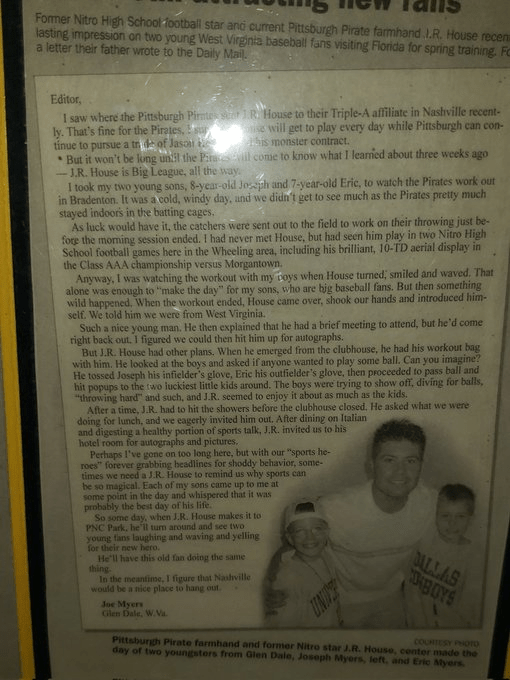
“Went to Bradenton in 2003 with my brother and two sons. There was a prospect, JR House, who approached us after a workout and made it a trip to remember. He’s from the Charleston WV area. I was so impressed with him and how he handled himself, I wrote a letter to the editor to the Charleston paper.”

Next up was Kevin…

See that’s some of the stuff I wanted to get to. The family ties that get strengthened by being there. It’s not just bringing your own family closer, its also about feeling a connection to players. Joe and Kevin’s kids will never forget those players, even if some of them wound up not being super successful players.

Craig Toth of our own site makes the pilgrimage every year, here’s what he had to say.

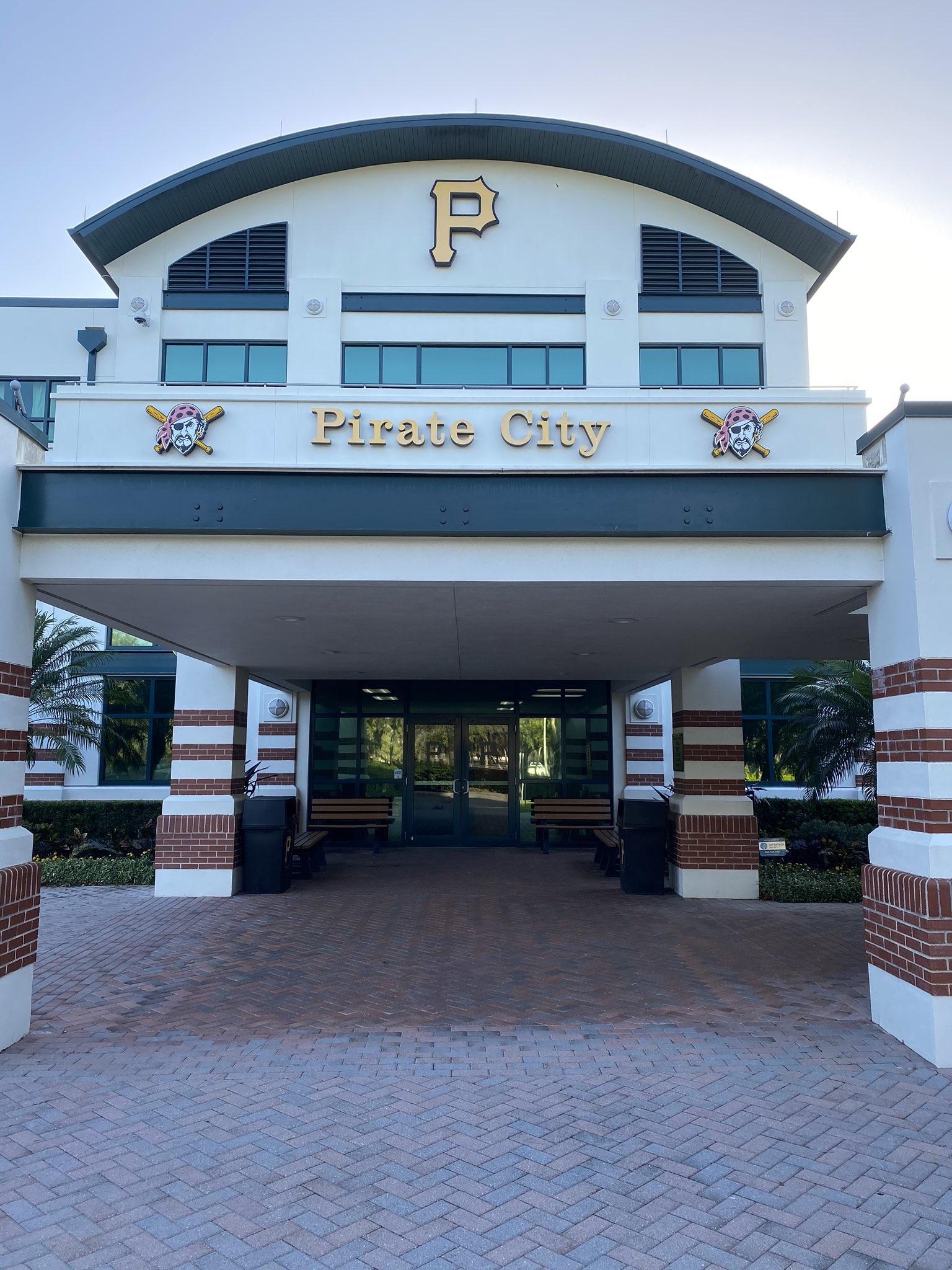
“Living in The Northeast, and having to deal with the bitter cold of a Western PA winter, heading to the warmth of Bradenton brings on a rush of feelings that are hard to explain. Even in the years where the hope that Spring Training is supposed to represent is little more than a pipe dream, walking into Pirate City for morning workouts-and maybe having the opportunity to catch a Minor League pickup game-just hits different. The clatter of cleats as Pirates players walk past fans in route to their next drill, the autograph hounds flipping through huge binders of baseball cards, family members meeting the other young men their sons have built life-time bonds with and small groups of fans with gloves looking to shag some homers hit over the left field fence. It’s an experience like none other; and one that every baseball fan should get to enjoy at least once.”

There are things you just can’t see unless you’ve done it, Craig is dead on there and it’s a theme I see and hear repeated constantly when talking with folks.

Bob Downy talks a bit about why it’s different too.

Jim feels largely the same.

These next couple speak to why baseball hurts itself and why some folks hold onto it even when it isn’t deserved.

Tim Waxenfelter had this to say “I’m not the biggest baseball fan, but I’ve done the FL spring training trip 16 times. My first cactus league trip was canceled at the beginning of COVID. I go with a great friend, and this guarantees we see each other for 4 or 5 days a year. We love the ritual of it and the looseness. Hanging out for a couple of hours in between the fields at Pirate City watching young players coached by guys I may or may not remember from their playing days reminds me that this is a game, a sport, and doesn’t always have to be a big expensive business.”

Man is that a mouthful. Truly well said and a symptom of what baseball has created both good and bad.

We’ve seen this before though right Michael?

Yup, and we learned so much from it that we’re repeating history.

Excellent point here by my man Greg, he’s absolutely right, we don’t think about this aspect.

On the plus side, I’ve been told by multiple sources that many players are planning to head down to Spring Training sites in the next couple weeks anyway, referencing difficulties in finding lodging and positive discussions with player reps. Take that for what its worth, but players don’t stop working and practicing regardless of the situation baseball has itself in.

I’ve heard it said by pundits countless times that as long as we don’t miss regular season games this will all be no harm no foul. These fans all say something different, and maybe that’s because to them it’s not about the grind of having your head on a swivel looking for stories.

Another type who isn’t talked about much is a guy like Bligh Madris. He’s worked his ass off to work his way through the system, gone to play Winter Ball in Australia, attended camps in the off season, all to get better. All to get to this point where he was almost assuredly going to get his first official invite to Spring Training.

He’s not a dumb kid, I’ve talked to him a bunch over the past couple years and all he wants, all he hoped for, was a shot. He knows what’s around him, knows what’s coming in the outfield, but this Spring Training in 2022 was supposed to be his shot.

He’s not alone. It’s probably going to cost some youngsters who wanted to have a shot at making the 26 man their opportunity too.

Baseball’s problems are bigger than losing Spring, but when this event provides opportunity for youngsters, older fans to introduce the game and being around players to the next generation, it really makes you question the wisdom of not trying to talk sooner.

Thanks to everyone who contributed to this piece, you all already put more into Spring this season than MLB has.

MLB’s Labor Dispute Has Reached the Edge of Reason

2-19-22 – By Gary Morgan – @garymo2007 on Twitter

Make it make sense.

I’ve said from the beginning of this, I’m fine losing games if it fixes the game, thing is, that’s not where this is headed. Instead what it looks like to me is the league fighting to keep things as close to unchanged as possible.

Instead of going on the offensive and fighting for something fans could get behind, they’re instead trying to fend off player demands and bending on some of them in the name of the very few things MLB actually cares about accomplishing.

In other words, MLB largely would have been happy with the system the way it was, adding in extended playoffs. So the first question, as a fan I have to ask is, why lockout the players then? I’d also ask, why propose the floor and reduced CBT level?

Those are two outliers that smack in the face of MLB not wanting much to change. One would be a huge change of course, and the other can be taken as nothing more than a preemptive strike. In other words, they had to have assumed from the player’s list of demands was going to ultimately lead to a strike situation.

Another possibility could be that with the CBT expiring, MLB didn’t want to go through an entire offseason before establishing/reinstituting those controls. This could be in an effort to control their own membership as much as anything. For instance, let’s say there are 4-5 teams that actively don’t want to go over the threshold but could, that’s probably a realistic number anyway. Well, without that CBT threshold being established, hell without the existence of a CBT it might pigeon hole the owners in negotiation. For instance if there are 6-7 teams beyond what the league proposes, it’s an easy argument to hand the players.

I’ll be honest though cause this is what I just can’t get past, if the owners win, I mean they get 14 teams in the playoffs, the CBT back in place, even if it’s a bit higher, the DH and nothing much changes beyond that of substance, was it worth losing games? Real hard for me to get there.

Now, if the alternative was putting in place even 50% of what the players have proposed, selfishly, it makes the Pirates situation even worse. That has me torn because, I’d still rather not have to lose games just to prevent changes to the game.

So, why propose the floor thing at all? Was it a threat, you know, intended to show the players if they don’t play ball this is the direction we’re prepared to go? If so, I question the wisdom of pulling it off the table as soon as players presented, like, everything you thought they would.

It would have been an ineffective cap system but would have at least built in the structure to build on.

The players of course want more money and to their credit, both sides have tried to creatively address getting money into the hands of specific types of players. Again, what’s the end game?

The owners simply aren’t going to eliminate revenue sharing, or reduce it. The owners won’t even discuss cutting a year of control for young players. And the two sides are actually growing farther apart on this weird pool of money they want to build for youngsters.

Feels to me like we’re headed toward missing games, with expanded playoffs, some minimally impacting bonus structure for young players, a slightly increased CBT, and a DH.

If you’re going to lose games, I’m sorry, you have to have something major you’re fighting for.

From the players side, OK, you’re asking for some pretty big movers there, I can see feeling losing games is worth it, albeit entirely unlikely.

So say this drags on, at what point does it become a loss for the owners to come back with no real wins? Give them what they really want, the playoffs, DH and CBT, is that enough to lose 30 games? What’s their F it point, and more importantly, what would that spawn? Is there a point where they’ve lost enough that they say to themselves, hey the only reason we were agreeing to these things was to avoid losing games, so screw that?

This is already the second longest shutdown in the sport’s history, so you’d have to think it’s on a path to the types of thoughts I’m writing here.

Here’s another question I can’t shake. If the goal was for minimal changes and to not lose baseball games, why wait so long to talk? For that matter, why continue to take so long in between talks?

Doesn’t that almost smell like wanting to lose games? Kinda feels like there’s a possibility this has all been an elaborate effort to reach an impasse, not a season’s beginning. Sorry, no way to do this without having you picture me writing this with a tin foil hat on, I know it sounds conspiratorial but the more I try to make sense of how this process has played out, the more I can’t help but wonder about the end game.

If they were to miss 60 games and somehow make things worse for teams like the Pirates, I think they’ll lose fans. Lose the same amount and have things stay roughly the same for the same teams, I think they’ll lose fans.

Lose games at that level and come back with something teams in fly over country can genuinely believe make things more plausible for them and their rooting interest, is break even. Lose even more games for an outcome like that and lose fans period.

So I ask again, what’s the end game? Those two paragraphs are my opinion of what some potential results would bring about, they certainly don’t have to share my impression of what fans would do or say, but they will assuredly have to confront it.

In other words, I don’t have to be right about what fans want to see or how they’d react, but the facts are, they’ll have to face it either way. A quick glance of social media, podcasts, journalistic coverage and even fake media like me and it’s plain to see, this is causing fan pain, and worse, the early onset of apathy. Apathy is a concept Pirates fans are much more familiar with than most fan bases. In fact, many of you who consider yourselves fans today are freshly back from your own bout with apathy as of the 2011-2012-ish timeframe when the Buccos lured you back.

I remember hearing people say they were done with the game because of inequities in the economics back in 2009 before catching the fever a year or two later. Only 15 years prior we were watching our team, that in 1993 had the highest payroll in the game suffer the first loss to the new power in baseball, TV money. We’d watch Barry Bonds walk away followed by Bonilla, and Bell, and VanSlyke, and well, everybody. And boom the strike over the owners wanting to institute a salary cap to nip the problem in the bud that everyone saw coming and some had immediately felt.

That was the moment where this pain should have been felt. It was manageable back then. They could have contained the issue, and much like the NFL grown with that system in place to collectively build a sexy and exciting product. One that could nationally present a random Orioles vs Mariners game in mid August and increase the chances it has meaning, if not playoff implications. Deep and more supported rivalries develop when more games are meaningful.

Players would still be making monster money, much like the other sports, these systems have work arounds built into the management of cap allowances, and with everyone having legitimate stake in making the game the best product it can be due to assured revenue percentage based distribution, the growth of revenue rises faster than inflation.

Alas, they didn’t have the fortitude to see it through, and wrestled back a modicum of control with the competitive balance tax, the control that is literally gone. The CBT had a wall, independent of the CBA. It took a while to start actually preventing anything. In the past 5-10 years though, fewer and fewer teams have felt compelled to exceed the faux cap. In fact, if you want an interesting thought exercise, Google yourself “Yankees Go Over Tax Cap”. Different markets are having entirely different conversations folks, and it’ll get no more stark than reading even just the headlines you see come up from that search.

Point is, this isn’t a game that is going to hurt itself with fans and easily recover. And that leads me to question why you’d willingly charge toward it for next to nothing in concessions. I’m not even saying this to either side in particular, neither are exactly poised for some major concession in my mind. If anything, all they’re doing is guaranteeing the next one is bloodier yet.

Think about it, say this agreement is for 5 years. The players will come back with a slightly lower percentage of earnings to revenue, but top paid players will still be setting records. The chasm from top to bottom markets will expand a bit more. We’ll all repeat all the conversations we’re having right now.

Well, as we discussed, not all of us will be conversing about it.

It seems to me a professional sports league has XX responsibilities. Not players or owners, but a LEAGUE (Players & Owners) in a parenthetical hug.

  1. Every Team is on Equal Footing
  2. Players & Owners are Incentivised to Be Excellent Via Shared Goals
  3. Fans Grow Toward League Invested, Not Only Team Invested

When you can’t agree on anything, maybe sit down and instead of starting out with placating phrases like “the fans deserve…”, start out seeing if you can come up with a mission statement as simple as what I outlined there. Even if it means nothing in the end, sit there and build a perfect picture of your league, with no preconceptions. What would make it work to suit your mission statement.

Tackle the problem from a different angle and figure it out. Let math lead your decisions instead of emotions and guesstimates.

I don’t know how this is going to wrap up this time around, but I do know they’re actively deciding that some of you are worth losing in an effort to get it done.

Hope it’s worth it.

Top 5 Pirates Prospects: Dropping The Hammer

2-18-22 By Craig W. Toth (aka @BucsBasement on Twitter)

With the amount of curling that has been ingested in my home over the past week or so, accompanied by my family’s regular viewings of Marvel movies featuring Thor wielding his trusty Mjölnir, it’s no wonder I have hammers on the brain.

Eventually, as the circuits started to really fire and began converging on one another, my thoughts-as they almost always do-drifted back to baseball; which in this case led me straight to a pondering of sorts concerning the evolution of my all-time favorite pitch, the curveball.

Over the years, the curveball has been given many nicknames; from the bender, the hook and the yakker to the deuce, the number two and the often used Uncle Charlie. However, it has always been my preference to refer to it as the Yellow Hammer because of the man who coined this specific label, former Pirates slugger Bill Madlock.

It’s the battle between pitcher and hitter being settled by a simply pulling the string instead of using brute force. It’s also a thing of beauty. But most importantly, when looking at the Pirates Farm System, the curveball is something that several prospects in the have come close to perfecting as a way keep the opposing team on their heals and constantly guessing.

Nowadays the fastball seems to be the popular choice as far as put-away or payoff pitches are judged due to the sheer velocity that is exhibited in their execution. Still, for me, nothing compares to seeing a batter’s knees bending and ankles buckling as the bat stays frozen on their shoulders; or in other cases, when the hitter swings so hard that he nearly comes out of his shoes, while twists himself around and falls off balance because he must have been thinking fastball.

Currently in the Pirates System there are many players that deploy the Hammer, yet there are about 5 that spin it better than anyone else I can think of.

1) Michael Burrows

Selected by the Pittsburgh Pirates in the 11th Round of the 2018 MLB June Amateur Draft out of Waterford High School in Connecticut, Burrows benefited from the Pirates inability to sign their Comp Round A Pick Gunner Hogland by receiving a $500,000 bonus ($375,000 over slot); resulting in him forgoing his original commitment to UCONN, and immediately beginning his professional career in the Gulf Coast League. In minimal work, only 4 appearances and 14.2 innings, the 18 year old right-hander didn’t allow a single earned run.

He then followed this up with a full season in the New York-Penn League with the West Virginia Black Bears, where he earned a 4.33 in 43.2 innings and across 11 starts. At the time, the main-and really only knock on Burrows-was the lack of a third pitch. With a fastball, that sat between 90 to 94 and a high 70’s to low 80’s curveball, he could easily make hitters swing and miss due to his unbelievably high spin rate; yet, there was still some concern at the time as to whether or not this would translate as he made his way up through the system in a starting role.

Now it’s possible, after watching Burrows perform this past season in Greensboro and the Arizona Fall League, that we have what could be a clearer answer relating to these concerns; however, before we get to that, let’s dig into the numbers behind that curveball for a minute.

For reference, the league average spin rate on a curveball sits somewhere in between 2430 and 2530 RPMs, while Burrows comfortably rested at 3000 over the summer. Also, tied into this is the vertical movement of -20 that almost unfairly pairs with a 25 on his ever rising fastball. Combine the two and you will probably be able to discover why Fangraphs currently rates the former as a 70 grade offering.

As we move back to take a closer look at the the 2021 season-one in which he missed almost two months with an oblique injury-it’s easy to see the progress he has made in his development by a merely looking at the results. In 49 innings on the mound for High-A Greensboro, Burrows posted a 2.20 ERA, a .898 WHIP and a career high 12.1 strike outs per 9. Then for an encore, he put up a 3.52 ERA and a 1.174 WHIP in the hitter dominated Arizona Fall League; finishing off the year on a high note with a scoreless, six strikeout performance.

Also it should be noted that his fastball ticked up slightly from 90-94 to 94-96-topping out at 97 mph-for all those fastball junkies; with what is still considered to be a below average change up mixed in.

Needless to say I am pretty excited to see what this young man can do in Altoona this Spring and Summer.

2) Omar Cruz

Originally inked to a deal by the Padres at the beginning of the 2017-18 International Signing Period for $100,000 out of Hermosillo, Mexico, Cruz began his professional career with San Diego’s Rookie Ball Affiliate in the Arizona League in 2018, before earning a mid-season promotion to the Class A Short Season, Tri-City Dust Devils. Between the two leagues he posted a 1.96 ERA, a 1.323 WHIP and 59 strikeouts in 42.1 innings.

To begin 2019, he once again found himself with the Dust Devils, but only for two starts and seven innings, ultimately being promoted to the Class A Fort Wayne TinCaps; where he started to display more command/control as his walk rate dropped from 5.62 per 9 innings over his previous three placements to 2.39 for the remainder of the year. His ERA did see a bump to 2.76, yet, his WHIP fell to 1.122, as his strikeout rate remained at a solid 11.39 batters per 9 inning pace.

Set to continue the strides he had made during his 20 year old season, Cruz instead had to settle for an impressive Instructional League performance, without a regular Minor League Baseball Season in 2020; and eventually a trade to the Pirates in the off-season, where he would be assigned to the High A Greensboro Grasshoppers.

Unfortunately for Cruz, his first start in the Pirates Organization didn’t go quite as planned, as he gave up four runs, walked five and struck out four in two innings of work; good for a 18.00 ERA. However, over his next six starts he sported a 2.36 ERA, while striking out 34 batters in 26.2 innings.

It was at this exact moment that Double-A Altoona needed a spot start. Inevitably it would be Cruz that would have his number called for what was intended to be a Curve cup of coffee. Be that as it may, Cruz obviously had other ideas, as he tossed six strong innings, did not allow an earned run or a free pass and struck out two; forcing Cherington’s hand into keeping him in Altoona for the remainder of the season. Over a total of 14 starts and 70.2 innings Cruz would put together a fairly steady line; consisting of a 3.44 ERA and a 1.300 WHIP.

The prototypical crafty lefty, Cruz’s pitches don’t necessarily jump off the page; often causing conflicting scouting reports from many reputable sources. Both Baseball America and MLB Pipeline see his curveball as a plus pitch, while Fangraphs rates it as below average; coming in at only 2300 RPM.

Ultimately not protected from the MLB portion of the Rule 5 Draft-which may or may not eventually happen-Cruz could see immediate action with the Indians in place of many of the Triple-A caliber arms currently on the 40-Man.

If this turns out to be the case, just remember what he did with his last opportunity.

3) Santiago Florez

On July 2, 2016 the Pittsburgh Pirates signed 16-year-old Santiago Florez to a $150,000 contract. At the time the young man from Barranquilla, Columbia was still growing into what is now a 6’5’’ 222 pound frame, but the Pirates obviously saw some potential in his fastball, breaking ball and overall mechanics.

After a full year of training and conditioning Florez made his professional debut in the Dominican Summer League pitching for the DSL Pirates, starting in 14 of the team’s 71 games that season. In his 14 starts, Florez’s youth showed as he struck out only 30 batters and walked 38 in 53.1 innings. He also posted a less than impressive 4.56 ERA and a 1.519 WHIP. Nevertheless, these less than flashy numbers did not stop the Pirates development arch for Florez, probably due to his inexperience and the fact that he was almost a full 2 years younger than the average player in the league.

To begin 2018 Florez was assigned to the Gulf Coast League (now the Florida Complex League), where he was almost 2 and half years younger than the average player in the league. Again Florez did not light the world on fire, but he also did not regress either. Instead he continued to progress little by little. In 10 starts and 43.1 innings, Florez lowered his ERA to 4.15, his WHIP to 1.385 and his walks to 23 (down to 4.8 BB/9 from 6.4). He also increased his strikeouts, up to 7.3 SO/9 from 5.1; doing all this in spite of the fact that his season was derailed slightly by an elbow tweak. For his efforts Florez was rewarded with his first appearance on MLB’s Top 30 Pirates Prospects, sneaking in at #30.

As 2019 began, Florez continued his steady progression through the system as he was assigned to the Bristol Pirates (Pittsburgh’s Advanced Rookie Level Affiliate) of the Appalachian League. And just like he had over the past two seasons, he continued to grow and develop. Florez started 10 games, just like he had the previous year, while pitching a few less innings (42.1). For the season Florez posted a 3.46 ERA, a 1.344 WHIP, struck out 36 batters (7.8 per 9) and walked 21 (4.5 per 9). The highlight of Florez’s season came in his next to last start of the season on August 20th against the Bluefield Blue Jays when he struck out 7, walked none, didn’t allow a run and gave up only 4 hits in 6 innings. At the end of the year, just as he had steadily progressed through the Pirates system, he also steadily progressed up the MLB’s Top 30 Pirates Prospects, landing at #22.

When Minor League Baseball finally resumed this past summer, Florez would continue his steady march up the Pirates Farm System with the Low-A Marauders. For Bradenton, the young Columbian would appear in 10 games (9 of them as a starter) to begin the season; and, to say he was dominant would be a pretty big understatement. Not only would he toss two complete games, but he also threw up a 1.71 ERA and a .858 WHIP during the time he struck out batters at a 12.1 per 9 inning clip; earning a bump to High-A Greensboro in the pro.

Unfortunately, this promotion did not come without its struggles. Over his final 43 innings of season, Florez saw his ERA and WHIP balloon up to 7.53 and 1.814, while his K rate fell to 7.5 batters per 9.

Luckily for him the one thing that remained consistent was the ridiculous break on his curveball. With a rate of 2800 RPMs he has regularly been able to lean on it as his finishing pitch, or really anytime he absolutely needs a strike.

For as long as Florez has already been in the Pirates Organization, it’s hard believe that he won’t turn 22 years-old until after the season starts. Although sadly, his youth won’t really matter much longer if he can’t put everything together.

4) Roansy Contreras

When Contreras was first acquired from the Yankees in the Jameson Taillon deal back in January of 2021, most were unsure as to exactly what the Pirates were going to get from the 21 year-old, 19th ranked prospect in New York’s Farm System. This was especially true due to the fact that much like many other Minor League players, Contreras had not taken the mound in almost a year and half; making many of the scouting reports on the young Dominican out of date.

During his time split between Staten Island and Charleston in 2018 and 2019, Contreras had performed pretty well; posting a 3.04 ERA and a 1.05 WHIP with 176 strike outs across 195.2 innings. However, it was a fairly unanimous consensus that he projected as a back of the rotation starter. All of his offerings-a fastball, slider and changeup-were seen topping out at average to slightly above average in the future. Sure he had the command as evidenced by a lower than average walk rate of 7.3%, still none of pitches really jumped off the page; not even his 92-95 mph fastball. Also, you’ll notice the lack of any sort of curveball whatsoever.

After taking all of this into consideration, it shouldn’t come as much of surprise that when Contreras first took the mound for the Curve this past season the results were a little bit unexpected at the very least. From his electric fastball that easily sat between 94-97 mph and topped out at 99 to a wipeout slider and finally a 2700 RPM curveball that played perfectly off the other two.

In his first start of the season Contreras struck out 11, walked none and didn’t allow a single run across 5 innings of work. Then a week later he went 6, struck out 11 again and only walked 2; still not letting a single runner cross home plate. Of course it would foolish to believe that this level of dominance could continue for the rest of the season. However, up until the point he hit the IL with a forearm strain at the beginning of July he came pretty close; posting a 2.35 ERA, a .091 WHIP and 12.72 K/9.

When he returned, Contreras was eased back into the mound, never throwing more than 59 pitches; even in his MLB Debut on September 29th. Over his last 5 starts he tossed a total of 15 innings, while maintaining a 3.00 ERA, a 1.067 WHIP and 12.6 K/9 despite a couple of bumps in the road.

Immediately following the season-and primary to get more innings due to two month IL stint-Contreras started another 5 games in the Arizona Fall League; ending the year with an eight strikeout, one walk performance across 4 innings for the Peoria Javelinas.

Now thanks to the MLB Lockout his immediate future could be on hold. After being added to the 40-Man back in November, Contreras is currently among the Minor League Players in the Pirates System-several of whom are on the cusp of regular MLB action-that would be unable to start the season as long as the CBA remains unresolved.

So for now, it’s possible that a Carmen Mlodzinski, Kyle Nicolas, or Noe Toribio could be called upon to fill out the Indianapolis rotation in the interim.

5) Quinn Priester

This young from Cary-Grove, Illinois is obviously a student of the game; and in beginning he was also his own pitching coach. Sitting in front of the computer for hours, Priester would watch endless videos of Walker Buehler, Kyle Hendricks and Jake Arrieta, along with all instructional videos in an attempt to hone his craft; which is highlighted in part by his 78-82 mph, 70 grade curve that he spins at 2500 RPM.

Drafted by Neil Huntington as his final first round pick in 2019, Priester caught the eye of scouts during the lost MiLB season with his brief work at the Alternate Site in Altoona, as well as his performance in the Instructional League that fall. Touted as a potentially being the best pitcher in the Minor Leagues headed into last year, the bar was set extremely high. Almost too high to actually be reached.

Due to these higher than high expectations some may look at Priester’s overall numbers and be a little bit disappointed, but seeing as it was his first full year in professional ball-and possibly playing a level up-it’s hard to hold very much against him; especially as a high school arm that usually takes longer to develop-its hard to feel that way. 

On the season Priester posted a 3.04 ERA and a 1.239 WHIP, while remaining fairly consistent for the entire season. His 4.26 ERA over his final three starts of the season was less than ideal, but we have to remember that he was fast approaching 100 innings after a season off the previous year. It’s totally possible that his young arm was just starting to tire; albeit at times, he was completely unhittable.

Conclusion

Obviously a dominant curveball isn’t the only tool in any of these pitchers’ repertoires; and, clearly it can’t be if they if they eventually want to succeed at the highest level. However to me, it’s the offering I look forward to seeing the most; as each of them channels their inner “Candy” Cummings across Greensboro, Altoona, Indianapolis and hopefully Pittsburgh.

As Ever, It’s All About the Pitching

2-16-22 – By Gary Morgan – @garymo2007 on Twitter

Will the Pirates be better in 2022? When does the window open? How can the Pirates avoid having the window slam shut?

Questions like these fly around social media constantly, and while each of them have a ton of potential variables, each of them share a common portion, it depends on the pitching.

The Pirates are one of the oldest and most storied franchises in the game, and that’s while acknowledging the past 40 years have been nothing to write home about. Success in this town has almost always been about the bats, the Lumber Company. Sure, they’ve had some good pitchers, but very few who you’d consider locks for the hall.

Historically, it’s always been a problem, even when the rebuilds or retools have come to fruition, the pitching was always just not quite there. It’s taken moves or acquisitions to get over the hump.

Thing is, as a Pirates fan, it has almost always felt like there were 2 or 3 guys we were watching and hoping would come to Pittsburgh and be the Ace. Ok, maybe enough of you have given up on that moniker and instead you just want a top of the rotation guy.

For instance, in the last cycle before going and getting Liriano and Burnett we all were looking to Taillon and Cole, then it was Glasnow. We all know what happened there, Taillon was quite possibly the most unlucky athlete I’ve ever watched, Glasnow was not afforded the patience or not allowed to use substances, I’ll let you decide that one, and was moved as part of a bad trade. Cole was good, but as with most young pitchers didn’t hit the height of his powers until after he was traded.

Oh there was this Mitch Keller kid coming, and Brandon Cumpton, maybe Cody Bolton who we’re still waiting on due to his own injury and COVID caused issues.

Point is, we were looking down at a couple guys, and I mean a couple guys who we thought might be “good” not saviors.

Today, I’d like to really dig into the pitching prospect outlook for this franchise as we sit here and we’ll do that by breaking them into buckets. I also am simply not going to mention the short term patch possibilities like Quintana, or Eickhoff. Just going to focus on who the Pirates are developing.

Bucket 1: Immediate – Near Term

JT Brubaker – He’s had two complete seasons in MLB and at 28 years old, he’s a classic late bloomer. People often forget for quite some time he was ahead of Mitch Keller in the system before running into injury trouble. He’s proven he has good enough stuff to get outs, unfortunately he’s also proven it comes with a realization that his stuff isn’t good enough to survive an off night or fatigue. If he keeps the homeruns under control in 2022, he’s someone who’s just getting started, regardless of age.

Zach Thompson – Another late bloomer at 28 years of age, Thompson was finally given a shot in 2021 before being dealt to Pittsburgh for Jacob Stallings. This is a big man, 6′ 7″ and 230 pounds the big Texan and former 5th round selection in 2014 finally cracked through in Miami. There’s a chance he could help the Pirates and if he does what he did last year he’s instantly one of their better options. Again, the age isn’t ideal, but the baseball age is exciting, he doesn’t even hit arbitration until 2025.

Bryse Wilson – The 2016 Atlanta Braves 4th round pick made his debut in 2018 and despite his age and experience level easily has the most seasoning of this bucket. He’s not eligible for arbitration until 2024 and much like Brubaker, ran into trouble with the long ball in 2021 giving up 15 in only 74 innings pitched. His approach and stuff looked impressive and if he figures it out he’s just getting started. A theme we’ll run into for a bunch of these guys.

Mitch Keller – The Pirates 2nd round selection in 2014 and former top prospect still has arguably the highest ceiling in this bucket. Being that he reaches arbitration eligibility in 2023 he’s also nearing the limit for chances to prove all the promise can translate to MLB. He’s certainly put in work this off season and he wouldn’t be the first guy to struggle early and find his legs late. He’ll be 26 this year, but as we’ve already covered his baseball age is further along than some others he’ll be competing with. That said, his ceiling tells me he gets every opportunity this year, and if it doesn’t work, they’ve done about all they could. Big Year for Mitch to say the least.

Roansy Contreras – Geez, if you haven’t heard his name yet, you sure will. He’s 22 years old and isn’t eligible for arbitration until 2025. Roansy is the Pirates number 6 prospect and has done absolutely nothing but impress since coming over in the trade with the Yankees for Jameson Taillon. The stuff is real, the velocity is repeatable, and more than most his age, he looks the part when the lights get brighter. He’s worth getting excited about, but he’s young and also ran into some arm issues last year which is always scary. Bottom line, if he stays healthy, he arrives this year, and gets more than a taste this time.

Max Kranick – The 24 year old 2016 11th round pick out of Scranton PA is my dark horse to come out of this bucket and reach his ceiling. He’s hitting 97-98 on the gun and seems to have advanced control of his breaking stuff. He arrived early last season and it’s likely going to cause him to have to work his way back into the opportunity this season, but his history says he’ll use the off season to fine tune his shortcomings and outwork his doubters. Even if he doesn’t wind up being a starter in the league, he’s got all the signs of a good relief arm and plenty of time to show who he is on top of that.

Wil Crowe – Many of you have probably already decided that Crowe is not only not a prospect but also not an answer. Wil has one full season under his belt and isn’t eligible for arbitration until 2024. What’s interesting about Wil is he pitched a significant number of games in 2021 and found himself near league average for WAR. That may wind up amounting to nothing, but it’s more than most of these prospects can say right now.

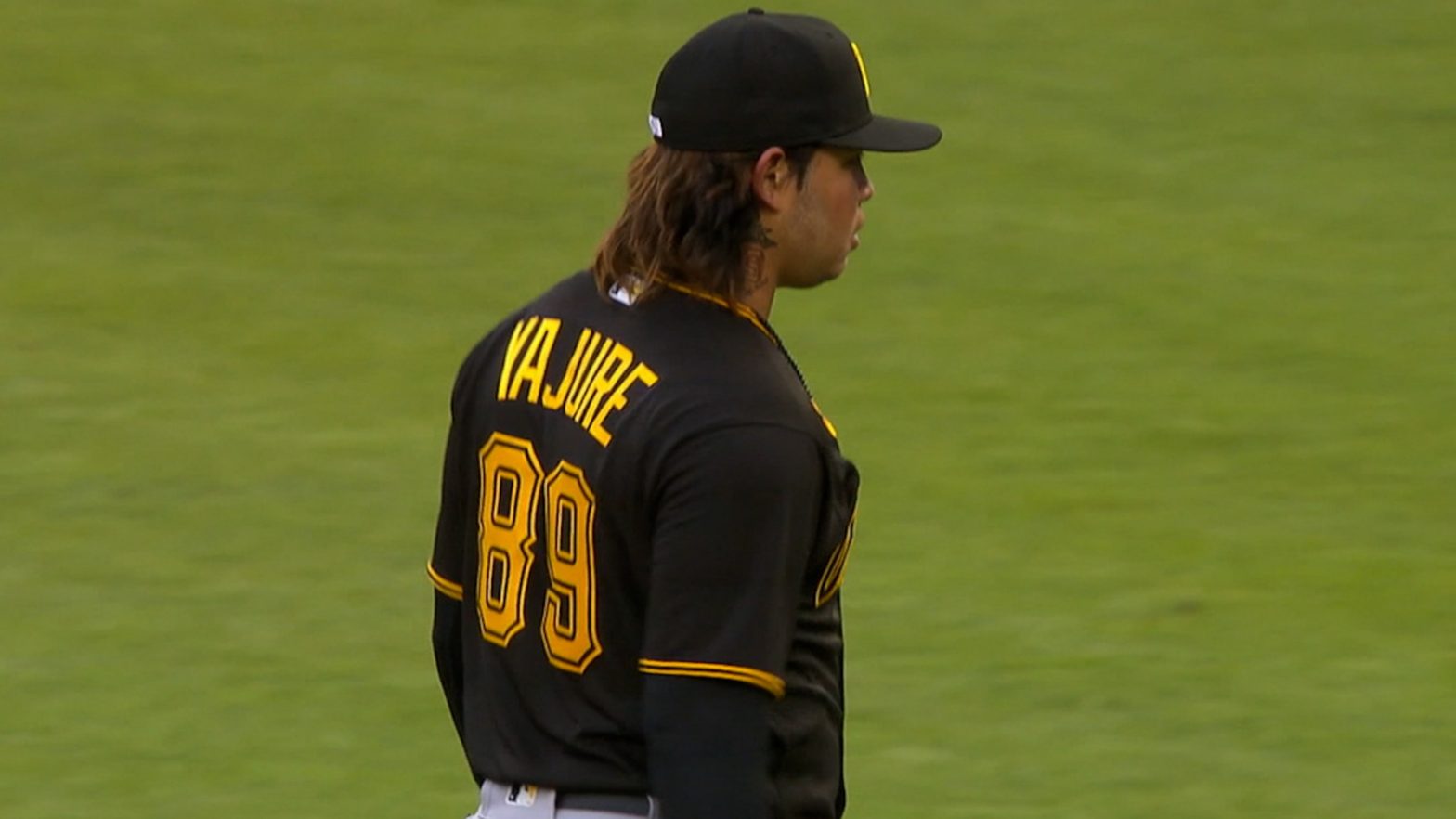
Miguel Yajure – Another player from the Yankees and the Pirates 25th ranked prospect, many have noted that Miguel has the most advanced breaking stuff in the system. In fact, before the season really got started it’s fair to say most fans were much more excited about Yajure than Contreras, and that could simply be because Roansy was younger and seen to be behind him in progression. Miguel ran into fatigue issues during 2021 but put together a solid AAA campaign. Hard to imagine a world where he doesn’t see significant MLB time this year.

Dillon Peters – I have a hard time considering Peters a prospect, but for consistency’s sake, I’ll let his arbitration timeline do the talking. He’s not eligible for arbitration until 2024 and the Pirates lack of left handed depth in both the rotation and bullpen scream that Peters has to be considered. Selected in the 10th round by Miami he’s bounced around and up and down, never really experiencing anything you’d consider success until the Pirates acquired him. In 6 starts he put up a 3.71 ERA and at least earned having his hat tossed in the ring for a gig in 2022. He’s not a hard thrower and his stuff isn’t particularly impressive, but something about his presence really spoke to Bucco fans in 2021.

That’s it, I see all of these players with a chance to make their contributions to the Pirates a longer stint. Out of those players I see three with really high ceilings and while I don’t care about their physical age all that much, the high ceiling guys are all under 26 and have a chance to play a role here beyond initial team control.

Bucket 2: Waiting in the Wings

Cody Bolton – Before I get into this one, I debated putting him in bucket one, but Cody has just lost too much time to assume he’s going to do enough to beat out that list I put there. He’ll be 24 years old this year and while I think it’s likely he’ll see his debut this year, I don’t see it being much more than that. Cody is an interesting talent, drafted in the 6th round in 2017, Bolton has mature stuff, but simply hasn’t stayed on the field. Breezed through both his short seasons and then 2019 saw him blow through Bradenton on his way to Altoona, he’d go on to start in 21 games and cement himself as one of the best pitching prospects in the system. He hasn’t thrown a professional pitch since. He was so impressive before the lost season and then his 2021 injury that he still ranks as the Pirates 29th ranked prospect. Yet to many fans, he’s a forgotten man.

Omar Cruz – Acquired from San Diego, Omar is one of the very few left handed pitching prospects this club has. He’s not a hard thrower, but he is in total control of himself on the mound. The Pirates 27th ranked prospect, Cruz is also my number one target to worry about being selected in the Rule Five draft. He’s easily advanced enough to stick in a bullpen.

Luis Oviedo – Yeah, you think you know him from last year, and I won’t lie, 2021 will stick with him until he’s proven it was more about how raw he was than his overall talent level. I expect Luis to start in AA this year and he’ll get an opportunity to develop into the starter he and the Pirates want him to be. This is either going to be a complete theft of talent or an unnecessary waste of a project. I do like his stuff, and even though I understand he was raw, I expected to see him improve enough to get 3 outs once in a while, the Pirates just chose to bury him.

Kyle Nicolas – The other pitcher returned in the Jacob Stallings trade, and arguably the more talented of the two. Kyle has stuff for days and his ceiling says to keep your eyes open. What makes Nicolas a great pick up is probably that his floor looks to be a capable setup style arm should starting not work out, but his control will really tell the story. I think he’ll start in AA, but I also think if they diagnose him as a bullpen guy early he could be in the majors as early as 2022. The 24th ranked prospect in the system, Kyle is the very definition of an open ended question.

Quinn Priester – The Pirates number 1 pick in 2019, Quinn is uniquely talented. He has top end stuff and his self taught pitch mix has taken time to refine. Half way through 2021 the Pirates started feeling they had honed in on his best 3 or 4 pitches and started letting him cut loose with them which produced success. Quinn is a perfect example of not getting too hung up on the numbers as you understand what he’s being asked to work on and how. The Pirates number 2 prospect is very unlikely to make the show in 2022, and not due to lack of talent, instead it’ll be more about letting him progress at his own pace and set up for a 2023 debut if everything stays on track.

Michael Burrows – The 14th ranked prospect in the system, Michael has just blown his projections out of the water. An 11th round pick in 2018, He blew everyone’s socks off in 2021 posting a 2.20 ERA and 0.898 WHIP in 13 starts with Greensboro and followed it up with a promising stint in the Arizona Fall League. Burrows is on the rise and is right on track to push Quinn along the same timeline.

Carmen Mlodzinski – Pronounced (Muh-Jin-Ski) was the 31st overall pick in 2020 and he simply hasn’t pitched much. He’s the Pirates number 10 prospect and has just rocketed upward in both expectation and performance. He’s been consistent since becoming a Pirates farm hand, but his availability to be available at 31 is a direct reflection of just how little he threw at South Carolina only appearing in 26 games from 2018-2020. He’ll be 23 on Saturday the 19th and will most likely start in AA, but Carmen could also jump past everyone else in this bucket if the team so chose.

Bucket 3: The Wave After That

I’m not going to write as deeply about these guys, but please don’t let that make you feel they’re less impressive. I could make a pretty strong argument I like what I see in this level even more than Bucket 2, there just isn’t enough on them yet to pretend I have a complete image.

JC Flowers – I start him in this bucket, but only because he just reached Greensboro. I love everything about this kid, but he’s just too far away.

Tahnaj Thomas – If not Cruz, Thomas is another Rule Five concern. The stuff plays but man he really struggled last year and he’s still the Bucs 13th ranked prospect. The reason his struggles are different than Priester for instance, he had a hell of a time placing his explosive fastball. A great comp for him is Luis Oviedo actually, which is why I think he’ll remain a Pirate.

Saniago Florez – Wow, impressed with his work in Bradenton, and despite his step back in Greensboro, he was terrific in 2021, especially after not pitching in 2020 at all. Excellent progress and he put himself in this conversation.

Now for the 2020 Draft group not named Carmen.

Logan Hofmann, Jared Jones, Nick Garcia – I mean, they each deserve their own listing but they’re also all significant as they all have impressed and have themselves on track for straightforward progression. Jared Jones has a shot to be VERY special.

Po-Yu Chen – The international signing also from 2020 should find his way to Greensboro this year and when he inked a deal with the Bucs, Cherington referred to his signing to getting an extra 2nd round pick.

Bucket 4: Pedigree With No Proof

Anthony Solometo, Brennan Malone, Eddy Yean, Bubba Chandler

Youv’e all seen Solometo’s funky left handed delivery and know about Bubba Chandler’s two way abilities. Eddy Yean is the piece that will ultimately determine how good or bad the Bell trade was and Brennan Malone needs to stay healthy.

13 of the Pirates top prospects are pitchers, and there has been a concentrated effort to bring in high ceiling pitching talent. Don’t get me wrong, this entire list isn’t going to come up and be the answer, in fact if half of them do Ben Cherington should have a statue erected on Federal Street. Pitching is often decimated by injury, and the sudden discovery of their wall. For instance, as good as Mlodzinski has been, as great as his stuff looks, he could find that AAA that stuff just doesn’t get the job done anymore.

I love to remind people that Mitch Keller was once the number 7 prospect in baseball, not the Pirates, BASEBALL. There are no guarantees, but you have to like what you’re seeing here and the near year over year influx that have a chance to make an impact.

I get excited about the future of the Pirates because of the sheer number of top end talents, because as hard as it’d be to have half of them succeed, it’d be even harder for 3/4 of them to fail or wash out entirely.

Before you start telling me who is and isn’t going to make it, keep in mind, to me it’s a numbers game, and these waves or buckets of talent are something I think will help make this whole thing come together either by contributing or as collateral to bring in more established talent.