
1-16-24 – By Michael Castrignano– @412DoublePlay on X
As the Pittsburgh Pirates headed into an off-season with heightened expectations, a key need for this team was clearly starting pitching. It makes sense as the team DESPERATELY needed arms in the rotation over the last two months of the season. Mitch Keller and Johan Oviedo took two spots but between ineffective attempted starters and bullpen games, it would often be a struggle. They were thirsty for arms to eat innings. Enter: Quinn Priester.
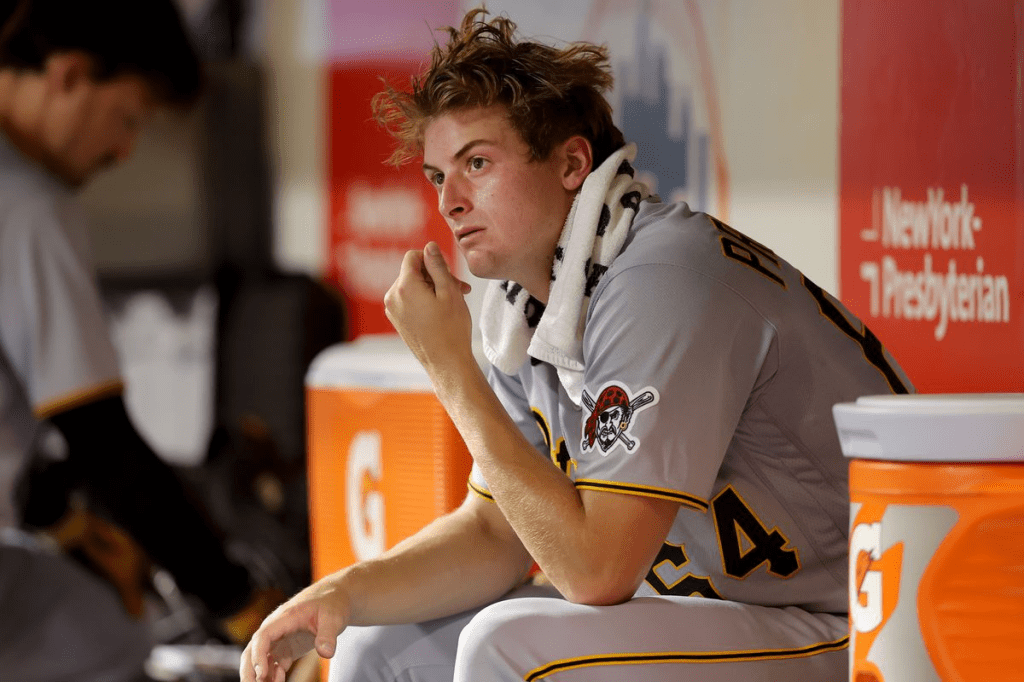
Wait! I know what you’re thinking: Another failed 1st round draft pick courtesy of the Huntington regime. Maybe you weren’t thinking that before, but likely are now. Before you break out the pitchforks ready to give up on Quinn, let’s talk about why you’re (maybe) wrong.
Starting with some background, Priester was picked 18th overall in the 2019 MLB draft out of Cary-Grove High School in Illinois. In a draft class featuring Adley Rutchman, Bobby Witt Jr., Michael Harris II and Corbin Carroll, Quinn didn’t have quite the success that these others did in their rookie years but, at draft time, it seemed like a solid pick. Pairing a fastball touching 97 and a low-90s sinker with a 60-grade curveball, the Bucs were banking on finding the next ace in their rotation.

After signing, Priester pitched 36.2 innings of rookie ball before losing 2020 to Covid. He spent the next season entirely at High-A Greensboro – posting a 3.04 ERA over 20 games and 97.2 innings, with 98 strikeouts to 39 walks – making the All-Star Futures Game and cementing himself as a top pitching prospect in the organization.
An oblique strain suffered late in Spring Training delayed the start of his 2022 season but, after adding a mid-80s slider the previous year, he continued his run across four levels of minor league ball, compiling a 3.29 ERA across 90.1 innings with 89 strikeouts to 30 walks. His WHIP dropped from 1.239 to 1.207 despite progressing upwards in the minors, reaching AAA Indianapolis to end the year, resting on the doorstep of the majors.
That debut would have to wait as he was very hit-and-miss to open 2023. Over his first 16 starts, he had 7 outings in which he allowed 4+ runs. He was more aggressively targeting strikeouts (81 over 79.1 innings over that span) but increased his walks (35) and hits allowed (78) as a result. This culminated in his last start on July 2nd where he went 7.1 innings allowing 2 runs on 5 hits. He would get his call to the Pirates shortly thereafter but it did…not go well.

Priester debuted on July 17, 2023 at home against the Cleveland Guardians, lasting 5.1 innings and allowing 7 runs off 7 hits while walking 2 and striking out 2. Quinn made two slightly better starts for Pittsburgh before a trip back to Indianapolis, where he keyed in on developing his sinker to be more effective.
The lowest rate of HR/FB (home runs to fly ball rate) across MLB in the 2023 season with a minimum of 50 innings pitched was 2% by Oakland reliever Lucas Erceg. The average in MLB is typically around 10%. Quinn Priester posted the WORST rate at 26.7% after allowing 12 (!) long balls in just 50 major league innings, a rate that should, theoretically, normalize over a longer stretch of games. Especially for a guy who posted 53% ground ball rate, ranking in the 89th percentile per BaseballSavant.
A big reason for that high ground ball rate, obviously, was due to that sinker. The point of the pitch is to get hitters to knock the ball right into the ground, so, makes sense. We’ve seen it work successfully with a number of Pirates pitchers both under this regime and the previous one.
Maybe Nutting is just a fan of the pitch. Who knows?
But the problem he ran into, as is common for young pitchers, was location. Take a look at these two pitch zone charts:


Ignore the number of pitches and percentages and just look at the location consistency on each from the 2023 season. One shows a pitcher who is unsure of himself and the other shows a team ace, who was in the exact same position 4 years earlier. Of course, back in 2019, Keller (who is obviously the second picture) wasn’t yet throwing his sinker – which he added and is able to utilize successfully because of his ability to command both it and his other pitches.

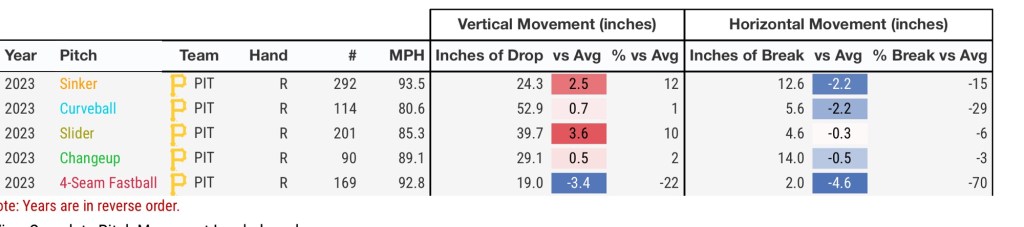
A quick look at pitch tracking shows that some of his pitches over-performed, some under-performed and some were just plain ineffective. Remember, Priester was reaching upper-90s on his fastball in the minors. But once he got to Pittsburgh, it was averaging 93 and typically running middle-middle becoming a wholly ineffective mess of a pitch.
On the other hand, he’s had a few pitches that maybe can become his go-to option for strikeouts. For instance, his slider had a 41.4% whiff rate, compiling 14 of his 36 strikeouts on the offering. It’s a pitch he added in 2020 during the pandemic and has been very effective as an out pitch. His changeup was used infrequently but only resulted in 5 hits (4 singles and a double) over 14 batted ball events and produced his lowest exit velocity of all his pitches at 82.9MPH.
So is it “Quinn for the win, or are we just living on a prayer for Priester?”
It’s hard to say.
For one thing, Priester either needs to get his velo back on his fastball and locate it up in the zone or scrap the pitch altogether. 93 down the pipe is batting practice in the big leagues and he will continue getting crushed if he doesn’t return to form on the offering.
On the other hand, his secondary stuff is getting such steep vertical movement that it might not matter how effective his fastball is if he can use it as a show pitch and then rake batters with his sinker/curve/changeup and finish off with the slider.
The team has a handful of arms who might make up the final two roster spots behind Keller, Martín Pérez and Marco Gonzales and Priester is at least in the conversation. Last year’s debut was rough but it was also a wake up call. It’s an enormous difference playing in Pittsburgh versus the sandlots of the minor leagues. But, at the end of the day, it is going to come down to Priester having confidence in himself and in his stuff.
And I think we are all hoping and praying he figures it out sooner than later.
 Steel City Pirates
I’m not seeing a byline, but great job, whoever wrote this! It goes into good detail about the statistical history, recent struggles, and path forward in a coherent, digestible flow.
This actually made me feel better about his prospects of breaking through, albeit still fingers crossed. Many drills can get through wood with ease, but few can go through the best steel, to use an analogy for the difficulties many players face leveling up in the upper minors and MLB.
The velocity drop definitely remains a valid and major concern, but I absolutely agree the 4-seamer can be a show pitch if needed, had the thought right before you posed it. If he must go more the “junk” path, I think his processes and mentality give him a better chance than average of making it work. That preposterous homer rate especially offers hope, as usually pitcher-friendly PNC Park should not be the home of someone with that high a rate–more of those likely turn into WTP this year, absolutely.
LikeLiked by 1 person
Hey Zak! I forgot the byline but since added it. Velo drop is concerning but I think it’s likely due to innings workload (90.1 IP in 2022 -> 158 in 2023) and should return in the spring. I didn’t get into it in the article but lefties did a disproportionate amount of the damage (28 of 43 earned runs and 8 of 12 home runs) so he needs to find a solution to the LHH problem
LikeLike
Hey, thanks, Michael!
Ah, that’s also good to know, thanks for that added insight
LikeLike
Great read. A lot of information that you made simple enough for me to understand. I hope you’re right about the innings being an issue on velocity but it seems rather strange for the 4 seam to have less velocity than the sinker. Big drop in velocity is a concern for Pirate pitchers so I hope that they aren’t “fixing” another pitcher. Looking forward to seeing what he can do from day one.
Nice Job!
LikeLike